September 19, 2006

DFIs Shrinking Spreads or Rising NPAs

Typewriters saw its end with the introduction of computers and so did the bicycles after motor vehicles. Is it time to see the slow death of financial mammoths called Development Financial Institutions (DFIs) and the rise of capital market and banks to replace them?

Post World War II, several countries nearly depleted with capital resources, struggling to develop their financial and labour capital, infrastructure. Banks with its limited expertise charged high premium for projects with large gestation periods could never meet the demands of these projects. This gave birth to special institutions called Development Financial Institutions (DFI) to act as a ‘gap-filler’ with the following mandate

  • Providing medium and long-term assistance to business undertakings in the form of loans, underwriting and investment and fill the gap created by banks who confined to short term financing and selective investing and a poorly developed financial market
  • Assisting new project ideas, undertaking feasibility studies, providing technical, financial and managerial assistance for the implementation of projects
Different countries have followed different objectives such as financing, promotion, building technical expertise for the functioning of DFI. Countries like Germany, Korea and Japan have transformed or devolved their DFIs after having attained the objective and with the better access to capital markets. India today is straddled with DFI under huge NPAs. This paper aims to establish that it is not only shrinking spreads and NPAs but more than that and the future of
DFI.

Looking back into its past

RBI was entrusted with the responsibility of building the success story of the DFI in our country. The Industrial Finance Corporation (IFCI) was the first special financial institution established in 1948 by an Act of the Parliament. This was followed with establishing State Financial Corporations (SFC) in 1951; currently there are 18 SFCs, ICICI in 1955, LIC in 1956, Agricultural Refinance Corporation (ARC), UTI and IDBI in 1964, RECL and HUDCO in 1969-70, 70, Industrial Reconstruction Corporation of India Ltd. (precursor of IIBI Ltd.) in 1971 and GIC in 1972. There are currently 52 institutions in this category.


Financial Health

The classification to understand the financial health for the DFI has been done in two broad areas: FIs are regulated and supervised by RBI and FIs that are not under the direct purview of the RBI. IFCI and IIBI which have been operating as providers of direct assistance are all in poor financial health while refinancing institutions such as NABARD, SIDBI, NHB, EXIM Bank, IDFC have done really well in maintaining strong financials year on year.

The most inefficient among DFIs are State established SFCs. In states like Orissa, Bihar, TN, W Bengal, Maharashtra, Haryana and Gujarat, these institutions have eroded their entire networth and have neither been able to raise fresh funds nor service their debt requirements. The causes for the same have been explained in detail below.


The causes of decline in the 90s

IDBI, ICICI and IFCI formed the triumvirate on which the country's project finance edifice rested. Of these, ICICI rapidly changed to face the challenges of the new competition while IDBI was forced to change when faced with huge losses. However, IFCI’s future is still undecided. A look into what caused their decline in the 90s will show the following reasons

Evolution of the Indian Banking System
The Indian Banking system is today well diversified with public, private and foreign banks competing for similar businesses. The expertise they have acquired to manage risks in extending finance to long term projects has reduced the need of DFI. The credit given by banks and DFIs as a percentage of GDP has increased from 3.9% in 1971-1992 to 4.3% in 1992-2000 .

Competition – A driving force for effective performance
UTI mutual fund today faces competition from more than 30 other mutual fund companies. LIC competes with Prudential ICICI, Tata AIG, Bajaj Allianz etc. In the long term financing, there has hardly been competition. Being monoliths, IFCI, IIBI and erstwhile IDBI had poor loan appraisal mechanisms, ineffective regulation leading to mismanagement.

Riding the Low Cost Advantage of banks
Banks enjoy the natural advantage of having easy access to lost cost funds, a primary contention for DFIs. With RBI removing the LTO option for raising funds, DFIs were forced to raise funds from the market. DFIs are forced to lend to projects at rates that could make the loan unfeasible for them to service its cost of borrowing. The average cost of borrowing for SBI in 1997 was 6.3%, whereas the cost of borrowing for IFCI was above 10%. While the cost has reduced to 4.5% for the current year, it still remains the same for IFCI.

Poor asset distribution leading to NPA’s
DFI had the following issues: High sector exposure , cyclical nature of business, limited checks with group and company, long term loans led to disproportionate asset distribution. SFCs, on the other hand had been extending term-loans to SSIs. They were burdened with high operational cost, poor assessing skills, and were extremely bureaucratic. It is estimated that they would require around 3600 crores of capital infusion to clean their balance sheet.

Indiscriminate disbursement of loans
IDBI disbursement was growing at a rate of 14 per cent, ICICI at 27%, and IFCI at 20% since 1992-93 when the industrial growth in the country has stagnated around 3.5 per cent to 4 per cent indicating poor appraisal mechanisms.

Development of the Indian Capital market
One of the primary objectives of DFI was to act as a ‘gap-filler’ in the capital market and help lending medium to long term loans. The resource mobilized in the capital market in the form of debt and equity as a percentage of GDP has increased from 0.6% in 1971-1992 to 1.7% in 1992-2000 .

Others
The Public Undertakings Committee found SFCs
  • Not following stipulated guidelines while sanctioning loans
  • Lack of constant monitoring leading to misuse of funds
  • Poor collection mechanisms
  • Corruption and heavy sectoral exposure
  • Political Interference

International Outlook on DFI

Internationally, DFIs have had significant changes in their functioning over a period of time. There have been two distinct models followed:
  • Anglo American: Market based which competed for resources
  • Continental Europe and South East Asian Economies: Financial savings was diverted to these FIs for investment.
Of the four DFIs in Japan, one was restructured and the objectives realigned to meet social challenges and the rest went bankrupt and sold to private banks. Korea’s DFI has constant shifted to focus the requirements of its government. Singapore’s Development Bank of Singapore (DBS) now functions as a full fledged commercial bank.

Recommendations on the future of DFI

Given the importance of DFIs role in as a ‘gap-filler’, the following are the key recommendations and shall be discussed on the basis of classification

Refinancing Institutions
NHB, SIDBI and NABARD can continue their status as a DFI till the existence of DFIs. However, they need to act as regulators for the section they are re-financing.

Sector Specific/Specialized Institutions

No changes are required to specialized institutions such as LIC, UTI, and EXIM bank etc. as they are competitive players and strong regulators. TFCI, National Co-operative Development Corporation and National Dairy Development Board should be converted to a NBFC and will be easier as they are profitable too .

Medium to Long Term Lending Institutions

Barring IDFC, IFCI, IDFC have shown heavy losses. The following are the options that are available for a turn-around.

Create an SPV or transfer them to IFCIs ARC Having completed this, the DFIs can be converted to a bank or an NBFC for the following reasons
  • DFIs need to be given access to markets to raise low cost loans
  • DFIs can cause systemic failures by not servicing their debt to insurance companies, pension funds. Hence, active regulation and portfolio monitoring will be needed from RBI.
  • By deepening our debt market the dependency for DFIs will reduce

Devolving the system of DFI:

Converting them to banks or partnering with an existing bank

The success of ICICI’s conversion to bank and the recent make-over of IDBI to a bank but with a DFI status, gives a strong case for converting the existing DFIs to a bank. However, converting to a bank is not fraught without risks.

Partnering or Converting to a bank: A discussion
Establishing a bank will require
  • Replicating an existing bank with no assurance of access to low cost deposits
  • Longer Time requirement
  • Heavy investment in technology
  • Statutory requirements to be met with your current portfolio
Given these conditions, it is advisable for institutions such as IFCI or IIBI to merge itself to another bank than converting to a bank . RBI should allow these banks to raise long term loans through issue of ‘Development Bonds’ to fund the projects the DFIs have expertise in.

Converting into an NBFC
It would be ideal to see most of these institutions as NBFCs than DFIs as they can be regulated by RBI.
  • Regulations can be relaxed on CRAR for profit making NBFCs of DFI nature .
  • Active securitization of loans to help deepen the market.
  • Compulsory investment from pension funds, postal savings in the lines of Korea.
  • Diversification into wholesale banking including term finance, working capital finance, cash management services, equity to projects. Others include exposure to sector, group and individual companies.
State Financial Institutions - A stronger dose

In spite of commendable performance from Delhi SFC, APSFC (NPA’s currently at 16%) significant restructuring is imperative. The following are some of the key recommendations for SFCs.

Short Term Solution
Consolidate the bad portfolios of all SFCs and transfer to an SPV that works like in IFCI
  • IDBI and SIDBI can restructure their loan exposure or convert them to equity. There would be a requirement of infusing close to 3600 crores from most states.
  • An effective VRS , requiring close to 230 crores will be needed to reduce employee overheads that contribute 15-50% to less than 1-3% .
  • Appoint a professional non-executive chairman with banking and finance experience and boards with experienced professionals, implement managementinformation system, adopt standard accounting practices and the EDIFAR should be updated with the defaulters list.
  • Cross-sell other products and increase fee businesses.
  • Prudent norms on exposure limits, in lines of banks, to specific industries must be established. Diversification of portfolio will ensure reductionof risk during adverse times.

Long Term solution

Banks have gained expertise in analyzing risk and have slowly started to increase their presence with in all segments including micro-finance . Given this current scenario SFCs have outlived their utility and should be phased out within a definite time frame. However, changing to a bank in the long run would be difficult. The opportunity should be constantly monitored and converted to a bank or an NBFC that can absorb the SFCs without affecting its statutory requirements.

Conclusion

DFIs had been the cutting edge of the Indian financial system and enjoyed high credibility as a more than being a ‘gap-filler’ .Recent losses with IFCI, IIBI, SFCs has changed the scenario. However, barring these few DFIs, others such as NABARD, SIDBI, NHB, and IRFC have done exceedingly well. However, the need has come to address these losses and look at the future of these institutions.

The government of India cannot escape from its obligation to bail out the sick DFIs. As long as the present legal structure makes it difficult to force delinquent borrowers to pay up, DFIs may have no option but to look up to the government. It can be argued that the current problem of NPAs of DFIs is itself partly the result of the acts of omission and commission of the government. It goes without saying that the long term remedy to the DFIs’ problem lies in the
development of the debt market. Converting them to a bank, that have gained the expertise of strong loan appraisal mechanisms, cheaper source of credit, better collection systems and active monitoring of disbursals and regulatory check would be more appropriate for the future of DFIs. However, it should be at the discretion of the DFIs. Active securitization, allowing long term development bonds, diversification, sectoral caps will further benefit by removing systemic shocks. It is much more than a combination of shrinking spreads or rising NPA’s that gets addressed.

September 13, 2006

Fines and the sham of it

Here are some interesting articles and something that I always thought was unfair. Read them at your leisure time and it has very little relevance to what I am planning to discuss today-
For some of us, clicking and reading is even more difficult than reading it here. I just sent the link to show that they exist and it is no fabrication from my side. Hence, I shall give a brief on most of them. Merrill Lynch was asked to justify their trades that they advertise as there was a 'big' mismatch between them and NYSE. Canara Bank was imposed with a 5 lakh fine for not maintaining the statutory requirements and the IPO scam is well known to most of us.

I shall just take the case of Canara Bank as it is easy for me to put my point across. Its fine was not maintaining the fortnightly balances on its CRR and SLR requirements as 'somehow' some balances from its branches was unnoticed by the head office. Not that it is impossible considering the number of branches it has, but then I always amazed at the power of modern technology in tracking everything, including me. Yet, it happened. Was this intentional, don't know. There was no 'show-cause' notice given to the public. If I was to look at it differently, things show a really different picture.

What if I did it intentionally. Look at Canara Bank's balance sheet. This incident happened sometime this year. The closing balance sheet deposits was close to 116000 crores. The company has to maintain CRR and SLR requirements on this-5% and 25%. The bank was fined 5 Lakhs for this. A small math calculation reveals this - Assuming that the company had invested the money in AAA rated 10 year paper instead of holding it in cash and G-Secs. So the bank should have maintained 34800 in CRR and SLR. Had the bank invested in AAA rated paper and the differential was 3%, this will boil to 2.86 crores for a day. Assuming it takes 2 months for the decision to take place and the fine to be given to RBI and as a good company invest the same in call market that is earning 5% returns. The bank shall now get approximately 7 lakhs as further interest. Have not gone scot free in this transaction. What has the company lost in this? A little bit on the brand value. Well, this is a financial transaction and will get reported mostly in business papers in a small section of a relatively irrelevant side or page where there is nothing else to fill. The bank can explain different reasons and accept that it was a mistake beyond its control. But was it?

The point was never to give a bad picture. I have been with Canara Bank and in all probability this could have just been an accidental error from their side and never intentional. However, if I were to create such a scenario in front of you, is it right? RBI should have actually estimated the profit on this transaction and levied charges proportionate to it. Yet it levied a standard fine. Is the regulator right in his decision or just plain lazy to take note of it? Look at the Merrill Lynch and the IPO scam. The profit has already been taken and the goodwill for Merrill Lynch in terms of being the best broker has already been decided. The incremental business has been created. Will the fine that the regulator imposes reverse these transactions? I do not know. If I were to be unethical, I would happily do so albeit not regularly that I kill this cash cow opportunity.

But then, I can do it, can't I.


The point to be noted is that I am using these companies as an example to explain my thoughts. This is purely a thought process.

September 07, 2006

HOV Services - Skip it

HOV Services - Exceeds Expectations?

HOV Services is a holding company and offers its services in the Finance and Accounting segment with its 6 key subsidiaries. They being in three different segments - Accounts Receivable Management, Enterprise Management Tools and Services and the third Insurance and Tax Services.

Investment Objectives

Investment for this IPO is between 81 to 97 crores depending on the pricing of the IPO, constituting to 32.3% of public shareholding.
The key objectives include planned capital expenditure (approx 25%), redeeming the units issued by its subsidiary (approx 70%), and further acquisitions

Investment Positives

The company is floated by promoters who have extremely strong background. While they are not paid any compensation for their work, they get excellent sitting fees of a lakh/month. Having read the entire prospectus, I could only find one positive aspect of investing in thi

Investment Negatives
  1. The revenue stream for the company is extremely risky, with most of its revenues coming from its top 10 clients and this figure has been increasing over the past three years. The revenues are contract based hence their pricing becomes an issue everytime the contract is up for renewal.
  2. The companys key revenues is from outsourcing and hence there will always be pricing pressure unless there is significant value addition
  3. The company has acquired other companies without having an independent valuation. This is dangerous as the company could end up buying companies at higher prices.
  4. Damages in terms of litigation exceeds 35 Lakhs.
  5. It is natural for most companies to give promoters shares at substantial discount. This company is no exception. The promoters enjoyed a fresh equity investment at the face value in January 2006. Surprisingly the same is now being offered at atleast 20 times the cost of this issue.
  6. The company is increasingly moving into the sphere of merely a pure BPO, whereing its clients save on cost when compared to their country. The reason is found in the sales mix of the company's 3 distinct subsidiaries. The share of it branded product division, EMTS, has reduced from 99% in 2003 to 12% in 2006.
  7. Also the company is increasingly looking at business in the two segments where there will be a price war with little differentiation to offer.
  8. The company has been buying out comapanies to generate its growth strategy. However, these companies have been coming at a premium now being reflected in the goodwill at which they are purchased.
  9. Two of its subsidiaries are under losses.
  10. The company's cash flow is a extremely volatile for similar incomes too. Given the nature of income that one would see in any other company, the same is just not true for this.

Strange ones

  • The company's capital structure, as usual, remains a mystery inside an enigma. Consider this-32 transactions in the last 6 months. A lot of internal transfers between companies, promoters, promoters' floated companies. The company forms companies for a specific period and transfers the stocks back to the promoters at the end of the period. The company has largely grown inorganically. There is so much confusion on the holding companies and internal transfers that after sometime, you wonder where this is all ending. This issue is anything but pure confusion on share holding. The maze of transactions can lead to false understanding of the company's promoters.
  • The company has floated options worth 5lacs to its employees creating further dilution to the capital structure.
  • The issue, inspite of being on the lower side, has solved the company to exit one of its promoters, if not undertake limited work of capital expenditure.

Conclusion

  1. At a networth of just over 11 crores and a book value approximately Rs. 13, the issue price is at 15 times its book value, extreme price for a stock in the BPO segment.At EPs of 5.96, the P/E works out to 33 times wheras its peers like Allsec are on the upper tens.
  2. One of the primary usage of the funds is to give the existing investors an exit route more than funding the business operations that will help the company to grow further.
  3. To me, the entire reading was like more of understanding who is the final owner of the company, rather than the business and the future of the company.
Such complex IPO's is worth a skip and that would be my choice.

September 06, 2006

ACE Constructions - Go on

ACE-Action Construction Equipment Limited

It is quite interesting to note that the company has changed its name thrice in the past ten years. Though most of it have been more of a regulatory requirement than merely to change it for namesake. The last time it changed, I could not reason the need to change to singular (equipements to equipment)

Moving to the most important part,

  • This issue is for 50-59 crores depending on the cut-off price of the offer
  • The company is issuing 25% of its capital to the public. Post this issue the promoters control on the company is expected to reduce from 87% to 65%.
  • Lead runners for the issue is Karvy and they are back after a long time


Reasons for the IPO
  • Setting up a new unit
  • ACE is plannning to use a part of this IPO in a joint venture with Tigieffe SRL, Italy, though nothing has materialized in-terms of confirmation of the venture. The prospectus says that Rs. 6.6 crores earmarked for this. Considering the nature of the amount, this looks like it is in the final stages.
  • Acquisition/Investments which is unclear
  • Working capital requirements
  • Brand building
  • Building a corporate office
The total cost for all the above is about 78 crores and will be funded with this offer by about 50-59 crores and the rest with internal accruals and debt.


Negatives for the Company

  1. The company looks to have taken a few loans with severe restrictions for the shareholder. The covenants on its loan, though is normal, looks severe on the management to take decisions on undertaking new businesses or expand its set-up using debt.
  2. Sales of the company has increased by approximately CAGR 95% however the expenditure has tagged along pretty well. Margins for the company was extremely thin except for the last two years, where the company had the ability to price it higher.
  3. The company has increased its balance sheet size by about 13 times in the past two years,wheras the business has increased only by about 100% annually in the same time. The company has given 25% of its balance sheet in the form of loans and advances. This loan is largely unclear.
  4. The company has declared dividend last year and it was the first in the last five years.


Interesting Issues

The company's promoters are extremely clear on their allotment of capital. They have constantly issued shares at face value barring the last few issues. The company conveniently capitalised its reserves into bonus shares in the year 2005. It is quite interesting for the company to have done it, as this will give the promoters access to the premium money it charged to outside shareholders from its previous arrangements. The effect was that the company pocketed a 25% CAGR return on their investment on that day. However, it was not the company's profits only that was capitalised but premium money. One of their promoters is Benett, Coleman & Co. They have bought the shares at 100 and it looks like there is a wait for this investor to encash his investment. The company is lenient to the directors, friends, relatives as to have given it at a lower price than the outsiders. The company has been extremely lenient with insiders and quite harsh on its outsiders.

The company's EPS is approximately 11.08. At 110, this has a P/E of about 10, which is on the lower side. The company's networth is 43 crores and the current IPO is for 50-59 crores.The book value of the share is Rs. 29 and this works at 3 times at current issue price.

The company has made strong cash from operations. The cash EPS from operations was approximately Rs. 15.

I like the company for the industry which is in and I would go for it if I had surplus funds. The investment will be needed for the long term. However, if there is any downturn in the industry, this should be the first stock to sell as it does not pricing power.

June 27, 2006

Shirdi Industries Ltd : Braving the sentiments with an IPO

After a long time am I seeing a company braving the current slide in the market with an IPO. The past few IPOs have been quite a disaster for companies. Air Deccan's take-off in this market has been quite unsuccessful as is the same when it launched its first flight. Hope it has a better flight journey in the days to come. The others like Vigneshwara Exports tried to lower the price like Air Deccan in the hope of increasing some buying interest. Well, it had to return its money at the end. Prime focus and Allcargo all have seen some erosion in prices. However, given these conditions, Shirdi Industries defying the market comes with an IPO.

These are my thoughts on this company....They are personal views and I do hope it is able to raise its money successfully.

  • Size of the IPO 44-50 crores
  • The issue will be open from the 29th of June to the 05th of July.
  • The company was incorporated in 1993 and the company is planning the current issue for manufacturing MDF and particle boards, flooring, door skins, laminates and door and furniture components


About the Company
The company was incorporated in 93 and primarily dealt with trading of forward sell options. Later, the company started to import raw materials from south east Asia and sold it under the ASIS brand. The current issue deals with this segment to increase its capacity in the manufacturing segment.


  • The company is in B2B and mainly uses its dealership to induce sales. Discount may hamper margins and also cash flow. The details on the cash flows has been dealt in the later section.
  • Sales is limited to a few states. The IPO does not talk of strengthening the distribution set-up, which I think is crucial to develop business in the long run.
  • Internal competition is mainly from local, un-organised sector. The plywood industry has seen a few closures due to unhygenic practices.
  • China is the largest producer of this company's product of MDF. The growth of this segment by China is around 40% while India's production increased by 2%. In the hard board, India manufactures 10% of Chinese production. Hence, any entrants of Chinese products will lead to a price war. India manufactures 0.4% of Chinese production.


Balance Sheet and Profit and Loss

A look into the manufacturing division of the company is revealing some startling results. The company seems to have done well in this divison. The company sales has increased from 80 crores to around 1300 crores last year. If you see the improvement in bottom-line, this comes to around 30% net margins (the assumption is that trading sales has a margin of 10%, other incomes and consultancy at 100%)

  • The ROE is around 11% as of last year. However, a significant portion of this ROE is from the manufacturing division. The ROE has improved from 2% to the current level
  • The ROCE, a better indicator of the business is also at similar levels of approximately 10%. This margin has moved from 8.5% last year

Depreciation seems to have been understated. The company has added 52 crores of assets last year, a 5 time increase in assets. However, the depreciation provision has increased only 35%. This can be possible only if the company has made substantial acquisition in land.

The cash flows of the company has been varied and strictly nothing conclusive is coming out of it. While the company has achieved a strong cash flow for the current year, the cash flows was negative on three of the five years. Also, the increase for the current year has been mainly on account of increase in creditors and the company has consistently increased its debtors over the years.

Capital Structure

Again, yet another disappointing capital structure for the company. The promoters have acquired the shares at around Rs.11. The company has made an allotment to a foreign company at around Rs. 53.84. With the euro currently at around Rs. 58, and the issue price at around Rs. 69-78, this company has got an exit option with about 18% profit in a year. Infact, the lock in period on this investment by this foreign company has just come to an end for 85% of its investment. Anyway, given that the promoters have made an excellent deal in this company, at buying it extremely cheap, its now time for the public to understand if this pricing is correctly valued.

The current issue has some interesting facts:
The company needs Rs.127 crores for its funding requirements. Of the 127 the company has already tied in funds of approximately Rs.87 crores. The remaining 40 crores is coming from this IPO. At current issue price of Rs. 69 the company is expected to raise 44 crores, giving it a margin of Rs. 4 crores. Well, that is around 10% higher than the company requirements. Will we see a reduction of price due to poor market conditions?

Investment Positives
The only positive that I saw in this company was the strength of the new business. The new business seems to have strong earnings potential given the sector of housing is seeing strong growth. The company has a strong pricing power given the margins on the business.

Investment Negatives

  • The company has not paid any dividends since 1998.
  • Company has entered into various businesses such as in finance companies, reality, and biotech. The group companies, especially one of them Poona Pearl Biotek has shown a 16 times increase in losses last year
  • Current networth is 38 crores and the company is raising close to 44-50 crores in this issue
  • The issue is two and a half times the current book value of the share and the promoters have acquired the shares at half this price
  • Legal Proceedings against the company's directors are a bit hazy. The promoters are being sued for acting on personal interests. Though the claims are on the lower side, it still raises doubt on the management.
  • The current earnings is at Rs.2.4 and even at the lower end the pricing of the issue will be at 28 times its current earnings. As a relatively unknown brand for the public, I personally believe this to be on the higher side.

Others:

  • Though the lead managers has fallen to Allianz Securities, Edelweiss Securities seems to have taken the onus of selling the issue to the market. 50% of the issue is being underwritten by this company.
  • The MOA has a whole paragraph of more than 15 lines on IT and the scope of operations it can undertake. This comes as a surprise, as it is the first time that you will hear IT from the company. The sales figures, does not indicate any revenues from this stream
  • The promoters group companies are a big question on sustainability. A host of companies, pretty closely held. Most of them are showing high variability in sales across years. While this is does not impact the company directly, however, a company that has not paid dividend in the past five years, and the promoters having a clutch of companies with high volatility in sales, does not ring the right bell.
  • The salary earned by directors are unnecessarily confusing. The perks are close to 2.5 times the salary being earned. At first glance, it looks like the company is paying only Rs. 35000 for the promoters every month. However, once you add all the perks it increases to around 1.15 lakhs on the lower side.
  • The company seems to be quite sure that the price change could be possible as it has marked this sentence in bold that the change shall by duly intimated to the exchanges.

Given the above information, I personally believe that this IPO can be passed and the investor rather have his money invested in the direct market. However, these are only my personal observations.

June 26, 2006

India - Arcelor and Mittal


Business Standard was covering an opinion poll today and the question was whether Arcelor Mittal combine will help India. He had given a yes/no as his options. Now, this was interesting and I was trying what it could be. Arcelor has no known presence in India. Mittal, atleast has given his word to invest in a 12 mln plant. However, his presence in India, considering he is an Indian, is pretty disappointing as he waited till last year to invest in India.

India currently produces around 1/3rd of the combine capacity of this merger. Around 35 odd million. The entire country! Arcelor produces more money than Mittal but the latter produces more steel. So what am I being an Indian going to get any benefit? The big guns of India with Tata, Sail, Jindal all produce steel and their exports aren't that great, compared to this giant combine. Tata produces one of the lowest cost steel in the world and Sail and Jindal seem to have done some decent work, inspite of being one being a PSU and the other was almost a sick company.

I am just not able to understand how this deal is going to affect India.

  • Are we going to get better deal on prices?
  • Is he going to manufacture something else that is on the higher end of the value chain in India, post this merger?
  • Will he stop his plans in India, now that he is got some incremental capacity in his kitty (close to 10% of the world production) and also considering that we have a government that is unclear on its policies?
I would not be surprised if the third happens as the government enjoys giving a decision and taking it back. The airport contracts, the SEZ issues on land requirements etc...

None of the above questions gets me a conclusive answer, but yet the results from the other readers was overwhelming 'yes'. I wanted an answer that had the option like - 'I am ignorant and hence inconclusive'. One thing that hit me immediately is that we like Indians to perform well and we back them for no apparent reason. Sania Mirza, Indian cricket, Arun Jain, Bobby Jindal, Vinod Khosla, the many known in US and the even more unknowns who are successful in other countries. W e support them as if they are here to help us move out of this rut with their achievements, but rarely we see that happen. We just sit back and applaud and have an empty happiness. Again, its a feeling that they will come and help us, because they have achieved. We, as Indians, must support, after all, he is an Indian.

Am I missing something that the others seem to have seen and possibly in plain sight?

June 15, 2006

Should the RBI hike Interest Rates

For the past few days, I have been tormented with this problem if it makes sense for the RBI to raise interest rates. Here, I am not talking of repo or reverse repo rather the CRR. I was quite surprised to see the rates hiked without notice to anyone. It caught everyone off-guard. It's sometime nice to see the power of RBI. Completely, neutral to government pressures. Even surprised to see the markets to have rallied the next day as I thought it was not a positive information for the markets to discount. Well, the markets have not been always rational.

The Fed has been hiking its interest rates over the past few years and its now reaching a level where the markets are increasingly jittery. At 5.25% we are at a all time high. It is increasingly removing money from Asian markets, which was largely leveraged from these countries. Also I don't know if he will be able to control inflation with this hike. The brunt of the fuel hike will cause further damage to inflation. However this is supply driven and demand driven. Our consumption of amount of fuel has remained more or less constant across two years. This could be important as one will not be able to change his consumption pattern too much because of this hike. He may reduce it, but the extent will be relatively small. Given this scenario, should India hike its interest rates. I have some thoughts on it.
  • Capital is increasingly required in most of the industrial sectors. Most companies have announced their plans to expand or currently in expansion. As we have a largely under-leveraged companies, they have been borrowing quite extensively from the markets or banks. So, it is going to affect their profitability. I however, doubt if these companies will curtail their investment decisions or defer them for sometime till they have some clarity. It is obvious that the world over interest rates are hardening, and hence makes sense for them to have their expansion plans at these rates, than later.
  • To a certain extent, we are handicapped to world interest rates. I don't deny that. I feel this rate hike has taken the speculative money and will increasing pressurize good money that can be spent as FDI to move out and Reddy wanted to prevent that by giving hints in the air. As I do not know our ECB completely, apart from what keeps popping in ET, my guess is that we still are not in the area of concern.
  • Being a capital hungry economy and the projects lined up in infrastructure being huge till 2012, the governor should be more interested in the areas of lending rather than the rate at which it is being lent. RBI forced banks to increase the provisioning for house loans, which in my sense was a good move as it changed plans for the banks to shift priorities
  • Directive lending should be bought back in place to ensure money is sent to the right sector. Now, here I do not want them to invest in agriculture, coz this sector is hardly growing and increasingly the money does not seem to reach the end consumer. However, with the kind of efforts that is being put in by ITC, Reliance, Bharti, HLL, Godrej, I personally believe money can be used elsewhere.
    • Money can be specifically spent on building effective roads, airports, sea-ports and railways.
    • Money can be spent on power. Somehow, the pace can be improved. With lending made aggressive, this can be done
    • Money needs to be spent in having clean water, education etc. as these will help the country in the long run
Given this picture, I don't think interest rate hike will affect us immediately but I hope he does not hike the core interest rates as it start creating the fear of building expectation of hiking interest rates, which an even more danger to the system.

June 14, 2006

SREI Infrastructure - A must buy

The reason for my posting some companies in my blogs is just to re-inforce myself if I was right in making a purchase of shares. After this crash, it makes sense for an investor to be a critic and understand if staying with the company makes sense. The recent fall in the share market has given tremendous opportunities for investors to look at his portfolio and make adjustments to them. Surely, the crash would have left most of us wounded with huge losses, but I believe this crash giving an ideal entry to companies that one missed in the previous rally. The rally gave hints of companies that have the potential to be better than the others, but have fallen as there no buyers and speculators have left them in the lurch. Ideal long term investors need to grab them and have the next round of gains.

I enjoy infrastructure based companies as it is not heavily dependent on outside economies. Most of these companies undertake projects for the development of our country. The only risk being whether such investments will yield the desired returns. Peter Lynch did well in the 80s investing in companies that focused on infrastructure. If I recall correctly, he did a 5 bagger in most of these companies. His reason was extremely simple. These companies do a big service to give the country the next level of growth. However, these companies will stop showing growth after the country has become a developed one simply because consumption can be easily monitored. You are not going to spend more on electricity just because you have more money. You probably will travel more-but the facilities that you need from the road, ports or in airports will become predictable and further investments into these areas would only enhance comfort marginally. Well, we are a long way off. We hardly have continuous power, decent roads to travel, excessively used airports created by the low fare airlines. So creating the opportunity for all companies in this sector to grow and grow much faster. I do not know if they would grow at a pace greater than the other sectors, but I am atleast confident on the government's commitment to improve basic necessities that is much needed for us. Hence this post and possibly more on these type of companies.

The main problem that I encountered in this sector is the investment that one needs to make. Companies that are in IT, Entertainment etc rely heavily on manpower. Unlike infrastructure, where companies consume massive capital, these sectors hardly have such requirement. Any deal with proper pricing can ensure reasonable amount of safety for the return of capital. Infrastructure based companies run a risk on this. They consume capital and you do not know if they will make money. The projects have a huge gestation period and have leveraged balance sheets. Small changes in interest rates is sufficient to make the project infeasible after a few years. I am bullish on the country and hence I believe that I am making the right sense of investing in these companies.

I shall be posting my views on a series of infrastructure based companies in the next few posts of mine, if I have sufficient time at my disposal. My objective is to try and make sense in the policies of these companies.

SREI Infrastructure could probably be one such company that falls in this segment. The company gave up its highs of around Rs. 80 from around a month back to the lows of Rs. 30 today. That is one mammoth fall for a company that is doing pretty well. A company with a slightly different objective. They are into lending and only to infrastructure based companies. I read their annual report, and a truly interesting one. Very colorful (the company is in a purple patch), loads of explanation of the core activities of the company, extensive information on the industry (it probably took half of the report, which is a good one). Currently trading at a PE of 7. Imagine. Why are people not investing then? The company at its peak was trading at about PE of 18. Capital and infrastructure based companies were literally murdered in this crash. Probably that is why it is trading at such levels.

Company is primarily involved in these segments
  • Equipment financing
  • Equipment leasing
  • Infrastructure Project financing
  • Projects that are based on renewable resources (extremely small but amplified in the report)
Company has some diversification, of which some looks unnecessary in
  • Capital Markets-generated marginal revenues, not making operating profits mainly due to increase in debtors
  • Forex Services-generated about 2 lakhs of profits, not generating operating profits
  • Insurance-loss making division and again not making operating profits and is moving into securitisation and asset reconstruction. Has created a new company that has a general license to market all insurance in one window. Company seems to have made some heavy initial investment not in assets, as the only asset they have is a computer. Sustainability in this seems to have some attractiveness as there is some synergies in business, especially in the non-life insurance sector.
  • Venture capital-looks promising but details of this company is a bit sketchy. The company is investing in infrastructure based companies in the SME segment. The profitability that the company has shown is impressive. The salary in the P/L gives an indication that there are not more than a few individuals, and that too in the lower rungs of the company
  • Retail Financial Services-made some huge investments in infrastructure, but the segment is highly competitive with banks being the market leaders. It is difficult for the company to position itself unless some clear differentiation can be created by the company.
Investment Positives

  • Paison Ki Nilami-reverse Auction - a concept of reverse auctioning on determining interest rates.
  • Direct bulk purchase of equipments from companies like Tata, Ingresoll Rand and ensuring their availability to its clients at cheaper prices. This fends off competition especially from the banking sector as their cost of borrowing is significantly lower. However, they would not purchase assets for lending them as leases. This activity has to be done by these companies.
  • Listed on the LSE-can be more transparent in its accounts
  • Its presence across the finance vertical, its expertise in consultancy, its reach
  • Good dividend yield at current levels. At 15% dividend declared last year, the yield is about 4-4.5%. We have seen the upside on this stock a few weeks back.
  • The company has done well in terms of customising its receipts with the cash flows of its client and has done well on the NPA front. Its capital adequacy ratio is well above the prescribed limit of 12%.
  • The company uses securitisation of its assets, buys from ARC's (can get at a decent price) to ensure lower costs are maintained.
  • The sales growth in its key areas are well above 30% and with more infrastructure based projects in pipeline and a capital starved country, the company should be able to maintain these growth levels for a certain period of time.
Investment Negatives
  • Heavily dependent on the condition of the economy and the pace at which government will announce its projects
  • Road projects are sometimes not viable investments. Any hardening of the interest rates can affect the project
  • Raising money for projects- Rating of the company is not attractive. It is at AA-, which is a comfortable 200 bps from a bank. This benefit will affect the company as competition from banks is bound to get fierce.
  • The other segments that the company is concentrating will give poor returns
  • The company has a corpus of only 2200 crores
  • There is a constant hint in the annual report that the company is not able to deliver its equipments on time due to non-availability. It seems to have mitigated thru bulk purchases.
  • Interest Coverage ratio of less than 2 is a big risk in a rising interest rate scenario. The company's debt equity ratio is frightening given the fact that the company seems to borrow quite extensively (close to 6) and the borrowing mix is heavily tilted towards term loans from banks and financial institutions
Overall, the company has shown promise and the report that I spent reading for more than 3 hours was well spent. I truly believe the price of this stock to bounce back and show better appreciation in the years to come. More updates shall be posted when required.

June 12, 2006

Transfering Assets-Yet again is it fair?

Company PRITISH NANDY COMMUNICATIONS LTD.
NSE Symbol PNC

Announcement
Pritish Nandy Communications Ltd. has informed the Exchange that the Company has received a letter from Reliance Capital Asset Management Limited, a body corporate that pursuant to an inter-scheme transfer on June 05, 2006 from Reliance Growth Fund holding 9,00,000 Shares of the Company constituting 8.5985% of the paid up capital of the Company to Reliance Media & Entertainment Fund, there has been a change in shareholder, but the percentage holding by Reliance Mutual Fund i.e. 8.5985% remains unchanged.


The above mentioned was in the communications sections today. I found this piece interesting. It is a normal practice for mutual funds to shift assets from one scheme to another, so ideally this should not have created any panic to the investor. However, some interesting facts :-
  • Sales of this company is extremely volatile. It was down from around 40 crores to 30 crores to back to 34-35 crores in the past three years.
  • The share is trading at close to a year low. Has participated in the downside quite well
  • Reliance Growth Fund is a flagship fund of the company and there is always pressure to perform constantly. The Media fund is less focussed than the hugely acclaimed Growth fund, creating pressure to perform.
  • The Growth fund is completely transferring all its assets to the media fund. Total assets of the scheme : 2800 crores. Transferred money of this company : 3 crores. Not much to show any impact.
  • Volumes are low in the market and this company is facing resistance at higher levels with huge 'sell' orders. Hence any share sold is further going to dampen sentiments on the stock
Yet the fund is doing it. Now what could be the reason? I just was thinking if this is the way wherein the fund is revamping its portfolio by transferring assets to other funds that are not that noticeable and can always be blaimed on markets of these companies specifically (one can say media companies, in general, have not performed) Just a wild guess.... but then I do not know. If it is so, then it is a disappointment from the fund house as the company is passing the buck of losers to these funds wherein the investors are forced to take the loss. Though the existing shareholders have not gained anything from this transaction, it gives the fund, the much needed liquidity to invest in stocks that have better potential to grow. It is similar to accepting the losses and taking fresh positions, but only this time it is at the cost of the other fund, infact their own fund.

All this could just be an imagination from my side, cynical of such a transfer. As mentioned previously, this happens most of the time in mutual funds. I just took this case to mention how this is applicable to save one's face in the worst of times.

Report on Annual Reports

The recent crash in the market has led to fewer IPO's reducing my workload. That was bound to happen. How long can we keep funding an unreasonable growth in the stock market. Someone's got to lose. Well, if not for anyone, I surely did. However, when I did ask a few of my friends if they lost money, I surely heard two reasons. I am there for the long term and this is a temporary correction long awaited and secondly, the long term story of the country is still intact. For the stock to move upwards, there should be a buyer who can find value once we reach back previous highs. I do not know who is that going to be. and as usual time will surely tell.

So what is exciting in these markets. My holidays gave me a huge list of annual reports to catch up on. I enjoy reading annual reports. It is like reading a prospectus. A lot of repitition making it complex and boring to read. If there is some regulation that requires repetition, then its high time the law some change. Endless repitition of the best performance and silently ignoring the important signs. As a shareholder, even if it means a single share, I get to read the important stuff of the company. It is true that the company incurs more cost to maintain a single shareholder, but then every shareholder has the right to be informed. This time around, till I see an IPO in the pipeline, I shall comment on the shareholders report and my observation on them.

I think it is important for every shareholder to read the annual reports. It probably gives insights to the company that one would have never thought of. For example on the recent budget proposal on ultra power projects. We get information that India is building 4-5 ultra power projects. One sees the shortfall in generation at about 75000 MVA. Now what do I understand by this. Can Reliance actually bid for this...does it have the competency to bid...no idea. Reading the reports, esp annual reports gives indication if the company has the capability to implement. Btw, for information the company only generated around 1000 MVA for the last financial year. The total generated in the country was 125 times his generation. Surprised, yeah so was I as Reliance always advertised as though it was the largest producer. It still is, but the scale is just not comparable. Public utility companies are far ahead in power generation. The annual report from the company was equally disappointing. There was no symbol of the newly formed ADAG symbol. Though I am not a big admirer of the symbol, yet it is a signature of the company and this was missing.

The report from Anil Ambani is always good to read. Somehow, though I do not know him personally, I like what he says. Comes out as a person who is truthfully and likes doing things within the constraints of the law, wherever applicable. The company actually has not done that well this year. The sales has been on the lower side. The company has reached its limits in capacity and incremental sales has to come from expansion. The company's foray in wind is disappointing and natural gas has had no buyers. No wonder he has not advertised this in his report. The company has revalued its assets. This could have been due to the de-merger between the two brothers. I hope this was the reason as I do not like companies revaluing assets upwards, esp. during boom markets, as they are not going to devalue once the market is down. The company has not charged the depreciation due to this upward revaluation on the profit and loss directly. They have used their reserves to make up the higher cost. This again is something unacceptable, revaluation is similar to having bought the asset that year. They should have charged it to the income statement directly without using the reserves. I understand the company has not done anything wrong, just that it is unfair to the shareholder. Next, on the company's general, distribution, administration expenses- the investment to the gratuity fund dropped dramatically. Could find no reason as the company had a slightly higher salary expenditure. The company should be completing its merger with Reliance Energy Ventures this year. Should this create an impact to the company? I do not have an answer as I am not clear of the shareholding pattern of the company. My ideal guess is that it would not have an impact but to be certain I need to know the shareholding pattern of the company and the extent of impact of this shell company.

Finally, I am definitely interested in this company for the following reasons. I am bullish on infrastructure based companies. Reliance energy has got approvals to build over 12500 MVA over the next few years. The investment should roughly be in the range of about 50000 crores. The company has reserves less than 10%. So, the company will be borrowing and given its credit rating, this should be easy. However, I will be concerned if dilution occurs due to FCCB, as they can demand steep discounts. I like the aggressiveness of the management. There is a definite hunger for success. The company has got Anil Ambani, and he too is like his brother in thinking big projects. The best of this team is that this is in a sector with huge opportunity of success. Growth will taper off in a decade but utility companies are as the name suggest- a requirement that can't be reduced.

The next one that I read was on Gail. I have been investing in this stock for a long while and I finally took the pains to read their annual report. Unlike the report by Reliance Energy, this was comparatively attractive to look at. This can be both negative or positive. Negative as the company is spending on something that is hardly read and positive as the company is proud. My take on this is that, the company ought to make it attractive as this is a PR material for the company and it is important for the company's management to be proud of its results. It does not have to be lavish yet a little bit of shades should do no harm. Coming to GAIL, the company is an ideal company with immense potential to grow. It is in the oil sector, yet the company makes investment on communication lines, which is irrelevant. You will see this getting disinvested or floated into a separate company soon. I am not happy with their investment. I do not see the synergies of business apart from the gosling that they are using for building them. It reminds me of a famous quote by Mark Twain- There are two times when a man must not speculate: One when he has money and the other when he does not. This looks like speculation with money to me. The company otherwise is making some good moves in investing in local bodies for distribution of CNG and LNG. The company still generates 70% of its revenues from its core sector of selling gas. Here is something funny. The company's vision is to ensure value is created to all stakeholders yet it takes pain to reiterate by giving importance again to environment and customers. My guess is that they do not believe these two as a part of their stakeholders. Its part time directors is a total disappointment. Two directors have attended just one of the 15, the best being 10 attended by another director. Wonder what value they add in that one meeting that they attend.

About 23 giving an PE of about 10. Ideal for a company with ROIC of over 27%. The company is suffering from the subsidy burden. It had to pick up a tab of about 1100 crores translating to about Rs. 13 per share. Well, one is helpless of the atrocities of government policies even if they are going to get something back in the form of Oil Bonds. Anyways, the company is in the right sector and the supplies that it is making to the power sector and for local consumption gives this company an ideal candidate for investment. It is still a govt defined pricing sector, and my faith of the current government is losing over the past few months. Yet I would like to invest in this company.

June 09, 2006

Declare Dividends by borrowing-Unfair

Something struck quite unique to me in the recent bonds raised by these oil companies. All of them cited losses if not for these bonds. They showed the receipts of bonds as normal sales. Borrowing of this money by the government as SALES. How can you do it. To top this, they have shown profits in their books and to further aggravate this they have DECLARED DIVIDENDS and the government has coolly taken this money what it gave to them in the first place. The government has borrowed money and distributed this money as dividends, when in reality they have been running losses and have asked ONGC, the scapegoat to bear the losses, as how much can the govt. bear. I have, for long, invested in ONGC as it was one decent company heading somewhere. Today, because of the government, I am forced to share my profits to not only these refining companies but to the entire nation. Just look at it this way. The government raises money from the public, thus raising its deficit. This is a long term borrowing to fund annual shortfall. First mistake funding short term losses with long term funds. Second, receiving dividends from these companies. Why are we borrowing more and receiving dividends and thus showing income in your GDP. This is wrong as you saying that raising capital is SALES. Though most of the dividends it received from this decalaratin by companies is small compared to the overall GDP, I still feel that the entry for this transaction must not be recorded in the books as dividends. There ought to be an alternative such as a book entry for the bonds received for the year and the excess or defecits charged to it rather than to the profit and loss account, where the government gets unfair benefits, (in taxation of profits and dividends received post taxation).

Well, my interest in this government seems to be falling apart for the past few months. There seems to be a lack of proper forecasting like its predecessor-the BJP. Inspite of their current shortcomings, BJP still has a few sound people which I am not seeing in this governemnt. Critical issues being held at gun point by the LEFT and failure to take the RIGHT choices, is keeping this government heading nowhere. We are lucky that this party is spending on infrastructure, else we might be in doldrums.

June 06, 2006

Vigneshwara Exports Limited - Another IPO

Well it looks like the stock markets just loves to see an IPO every week. So next in line is this company. The company is based out of Mumbai and the office is in Parel, a place where I was staying for two months. However, the place has seen tremendous appreciation of land value, but as this place is only the registered address and also since I have not seen the place I shall not comment on it. Anyways, coming to the IPO, the issue has been priced between Rs.121 and Rs.140. The IPO looks to gather around 50-60 crores from the market. Compared to the previous issues from ICICI, ONGC and possibly the DLF issue, this looks like it will hardly have any impact on the market and will comfortably sale through even the company does not advertise in the market.

This issue is not fraught without risks.

First, that comes to my mind is the promoters stake. The promoters are diluting their stake in the company to below 50%. I do not understand the reason for such a drastic step for the company.

Second, the company was into diamond trading for the past five years. Post this issue the company is planning to exit from this business. Now, that is something that needs attention. The company has entered into a field where the competition is already on the higher side creating heavy pricing issues. This should have been forecasted before entering. However, the company seems to have taken the poison pill and have decided to move from it.

Third, VEL is getting regular business from existing customers. Its top 5 clients have account for more than 75% of the business. Though this has been reducing over the past few years, this is one factor that I would be keen to looking at during the coming few quarters of the company. The company is a regular in a show in Germany for the past 15 years but it has not been able to increase its customer base for these many years. One should give this some thought.

Fourth, the company's pricing policy without using LC. As far as the customer is a regular for the company, this strategy works fine, else one would consider the risk for non-payment.

Fifth, the company's capital structure-post 2003, the company has changed the capital structure 7 times by bringing in fresh capital. However, the company has always issued the capital at extremely low cost to the promoters. Till 2005, the company issued at Rs.60 to the promoters. This was increased to Rs.100 in a month. I have no reason why things changed dramatically in a span of couple of months. The promoter will actually double his returns on his investment made last year. However, if one looks at the issue, the company has issued to the promoters at about 6-8 times earnings. Sometimes, I do wonder, if it right for the promoters to have issued the shares at such low prices when he knows that he has the option to dilute his stake when he brings his company to the public. Finally, a small irrelevant issue, the company's prospectus was mostly referring to the opportunity in US when it hardly has operations in that country. The company only has plans to enter into this market after the issue.

Positives

While we have spent our time on the negatives of the company, here's the brighter side. The company has been growing aggressively. Assets have grown by more than 14%. Inventories though has been a problem with certain years of poor forecasting, but the company has increased its sales by more than 150% in the past five years. The company has a CAPEX of 200 crores in the next few years and have lined up their capital. The company is making use of the Technology Upgradation Fund provided by the government. The rest is being funded by the IPO which is expected to raised about 55-63 crores. However, the company has sales of around 1200 crores for the past couple of years. I like the industries' prospectus with immense potential to grow.

Neutral

The company's capacity utilization has been below expectation and the bottlenecks seems to have created the problem which is being addressed with the cash inflows from the IPO. The company is increasing reliant on external supplies for its raw materials. Though this will be reduced by the IPO, this still is a concern that should be addressed by the company. The company's will be investing in heavy machinery. Hence the company should see a higher tax benefit and some security to the cash flows. The company has faced problems in dispatching within deadlines. With no cover from LC, one needs to know if there could be some risk. Power will be a concern for the company but the company seems to have addressed this issue-by hoping the government will provide with the necessary fuel.

I still am not quite clear if this company will provide the necessary appreciation that one is looking at. The cash flows which still hits me constantly is the main source of concern. However, I do hope the company will be able to manage the cash flows better. Also, the company's pricing policy at Rs.121 - Rs.140 will make it expensive today when compared to its peers. But Invest thinking of the future of the industry.

May 30, 2006

Allcargo Global IPO

Allcargo, a company that I spoke of in my previous blog. A prospectus that will make you sleep quite comfortably. To the point, I think this is yet another company that is promising more than average returns though it looks like the company has the prospects to do so.

The company is involved in logistics and has quite a history in this field. However, you will see that the company has used a few paragraphs repeatedly throughout the prospectus. In the first instance it was unnecessary as any person who is reading the first section will remember what he read and even if he does forget, a simple remark of the page would have done so. However the company insists on repeating forcing the reader to re-read. Anyways, writing a prospectus seems to be an art which ENAM is yet to master and I shall hopoefully not delve on this issue any longer.

What I liked of the company was the prospects of the industry. Again the company's will be extremely dependent on the infrastructure that the government needs to invest in. However, given the fact that considerable investment is being done by the government atleast in the improvement of ports, this company is promising to deliver something that is achievable.

The pricing is also comfortable. It recently had placed a part of the equity to outsiders at similar prices hence making the company slightly more reliable. However, the company's promoters loved to juggle their shareholding at extremely cheap prices. A share that the company's promoters should have sold for atleast Rs.350 was sold for Rs.10. Also the company has given stock options at Rs. 10 which can be exercised in the near future. However, this will not dilute the stake as it marginal in nature and would not affect the profitability when charged to the income statement.

The investment proceeds will be used for building infrastructure for the company in certain regions such as Chennai. Also, the money will be used to pre-pay debt. This is something I was not comfortable as the cost of the loan is only 11%. The company has strong cash flows and could have used that to re-pay the loan. However, this is the company's decision.

Anyways, the company has fairly valued its stock and do not know if it provides reasonable appreciation. However, when one compares to its peers, it looks there is some. Time would be the judge for this. Investing would be ideal for a period of 3 years, is my best estimate. Why 3 and not 5? Coz I am a long term investor, and prefer 3 over 5.

Reading a Prospectus

Over the past few weeks, I have taken some fascination reading IPO prospectus'. It takes a long time as an average IPO prospectus for an equity investment has about 150-300 pages. Given the abundance free time that I seem to possess at my place, this does not seem to be a problem.

Obviously not everything is interesting and you can comfortably skip about 50-75 pages. However, the rest of the pages are interesting as they always give a wonderful picture of the company and the industry. It always tries to give you a feel that this is the company that will give you a 'ten bagger' or atleast a 'five bagger' (A 'ten bagger' is a term used for companies whose share price moves by 10 times, a term borrowed from one my gurus, Peter Lynch).

Most prospectus follow similar pattern of reading. This is extremely useful as one knows when to skip pages. I do not have any interest reading the general risk factors, endless repition of financial statements (which I shall comment upon later), statutory disclosures etc. We all understand that cigarettes are injurious to health yet it still does not prevent the smoker from enjoying his five minutes of absolute freedom.

Anyways, I enjoy reading certain specific sections of the prospectus. First, the industry - gives a wonderful picture, as always, the growth prospectus, how India is always in deficit of these basic requirements, commitments from the government (which I do not know if it will be implemented) to improve them which will be repeated from infinite number of times, outsourcing that will always happen to India and nowhere else. While it sounds pessimistic, I enjoy these statements because it tells me there is so much scope to improve in the country. Developed countries would face this biggest concern-the reason for government to spend hufe amounts of taxpayers money. India, being deficit in almost every area, has no problems. Outsourcing is a reality and cost savings are huge for companies. So, every prospectus reinforces the same issues.

The second part I enjoy reading is the company's prospects to grow in the near future. Most of them tend to be leaders in their category and almost all of them are planning to grow more than industry average. I do not know how everyone is growing at above industry average. However, this statement is something that one sees and cant help laugh at it.

The final part is the capital structure and what it intends to do with the money. This part is significant and it helps me to understand if the company is interested in building wealth to the shareholders. I like companies that repay its debt, however as far as it is above the cost of equity. As interest rates are low and most companies are 'leaders' in their industry this can't possibly happen. However, most companies seem to be expanding their capacities. Scalability will be important as companies can play with their cost structures effectively and hence gain advantage on pricing. What is most concerning is the kind of allotments the company has made in the past to its shareholders. Focus IPO for instance alloted at a steep discount to its preferential holders a year back but where charging the new investors thrice the comaparable cost. A comfortable exit option to the existing shareholders. I like reading the section that deals on civil and criminal suits against the company. Deccan Aviation tops this list. The suits against the company ran to three - four pages and it was fun reading the reports. This section is important as it shows light on the quality of management. However, the number of complaints is related to the industry, as a company that is in the end of the value chain is bound to face more. Directors of the company and their profiles is another good area of reading. Again Deccan Aviation tops in this. One of their directors is a director of 52 other companies too. If every company keeps atleast 5 board meetings a year, he will spend most of his official days just from one board room to the other. Something has to be done on this issue. You can't have directors, who are meant to safeguard shareholders interest being a director in so many companies. However this is India and as I said earlier, huge scope for improvement exists.

Finally and most importantly the current balance sheet, profit and loss and cash flow statements. This is something you will see frequently in the prospectus. Comany's projection seems to be there on every page of the prospectus, ( exaggerated but cant help myself). Yet reading this gives me an idea on whether to invest or not. Well, what I do like about these IPOs are that they do meet their projections in the near future once they are listed. As I do not track most of these companies post their issue, I do not know what has happened to their projections. My guess is that they should have met them as the stock markets seems to be quite embarrassed to list IPOs at par and most of them have done well even past a few quarters after their listing.

Currently I am reading a prospectus on Allcargo. Lemme see what fun this prospectus beholds to the reader.

May 29, 2006

Prime Focus an IPO - Focus on IPO

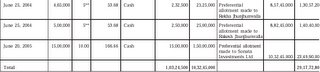
Prime Focus has come out with an IPO from May 25th -May 31, 2006. An interesting IPO coming from a sector that seems to be doing well-the entertainment sector. The company's performance has been stunning. The sales has grown by 60%-80% CAGR across three years. The PAT has shown even better performance. The company decided to price the issue at trailing PE of close to 50 on the lower side and updwards 70 on the higher side. Considering the performance and the future plans of the compny, it looks like the share price is fairly or slightly over-valued. My problem is not on the price of the issue but on this table that was in the offer document.


I do not know if the above image is clear or not. It shows three transactions, preferential in nature, made by the company to Rakesh and Rekha Jhunjunwala, and one company Sonata Investments. Rakesh and Rekha got the shares of the company at close to Rs.66 in June, 2004 and Sonata got the same shares at Rs.166. I have no problems on the pricing of these issues, though I am disappointed that the former two got the company at really attractive prices - a P/E of less than 17. Sonata Investments got the same shares at slightly above 17. While these two investments is reaping them enormous returns, the poor shareholder of the current issue, will be forced to wait for a long time to get the returns that these three investors are enjoying. If this is what one calls "Angel Investing" or Venture Capital Investments, then it surely looks like they robbed the company blind.

The fresh investors do not have to worry too much either. The company has a wonderful option for them. The IPO has the stablisation scheme for a period exceeding not more than 30 days. A simple scheme wherein the director has 'loaned', if I could use that word, to the book runners. They shall 'ensure' that the price does not fall below the issue for this period. So, the investor is atleast 'reasonably' assured of downside protection.

Yet, for a company that seems to have done well, atleast on paper, with strong cashflows, it seems to be a letdown on pricing. However, we are on a bull market and we have funds that invests in IPOs. Hopefully, they shall bring some upside to the stock.

May 24, 2006

And the crash....

I have always enjoyed crashes in the past. I enjoyed the stock markets around 2000 when everyone was excited seing sensex touching 6000. Balloons were flying around BSE to mark the fresh high. I loved seeing this crazy act by brokers, who are otherwise meant to be silent and unknown to the rest of the world. And then it happened, the inevitable or the truth prevailed as the Sensex crashed and it was the start of a long period of consolidation. I started investing at 3800 levels. What more exciting would it be to see the Sensex fall further to 2900 before the reversal actually start. Each time it fell, each time I would 'buy'. As a small investor, I feared that the stock markets would actually reach an all time high before I could invest my surplus money completely. This was my learning during the times it fell.

Things took a totally different turn this time around. Today I do not have surplus money to invest, I took money out of my treasure chest, close to 10% of my portfolio, which I always keep it liquid money, waiting for an excellent occasion to invest. I thought that day was last week and so I started investing in a stock that fell by 10%. It fell the next day by another 10%, I thought this was an amazing bargain and I invested further. Atleast, one thing I learnt was to always build a portfolio of stocks slowly. There is always time in this market to make money. But to my utter dismay, the crash occured on monday, and god it was one hell of a crash. I saw this stock fall by an amazing 20% in about two hours. Well, to compound this, the stock fell again the next day when most stocks were moving up. One of the "Blue-chip" ones that is beating me black and blue. But then that is life.

I tried to analyse if I made a mistake in my buying process. Not too many mistakes, but yes there were a few. The stock was pretty expensive but comparitavely cheaper than its peers. A leader in its field with business in India and outside. Well lets see what the future holds for this stock.

March 07, 2006

Credit Ratings : Impact on Equity Markets

Crisil, ICRA, CARE etc all perform some activities that I never knew could help in understanding equity markets. Infact little is known of the help that they do to understand the pricing model for any company. So what is it that these credit agencies do that I found out recently :). While I do not know if this idea makes sense, but yet I shall publish what I think should be right.

Credit Rating Agency - A brief understanding

Assume an unknown company wants to expand its operations but it does not have the funds to do so. The company has a few options. Raise funds in the form of equity or debt. Equity is expensive but debt can help in saving taxes and can ensure that the company performs well as it is forced to service the interest and principal. Further assume that the company decides to raise debt. It faces a new problem. How can the company attract the investor who can be sitting anywhere in the country. Here is where the credit rating agency comes to rescue the company and the investor. A credit agency is a registered entity from SEBI and they help in rating companies to help investors compare companies before investing in their debt securities. Ratings are assigned on different parameters, such as type of industry, growth prospects for the industry, level of competition and most importantly the strength of the balance sheet, profit and loss and cash flow statements. Credit rating agencies assign a Sovereign rating for Government securities as there is no risk of default. The only risk will be on liquidity and this is also on the lower side. However, companies are given different ratings and they range from AAA, AA, A, BBB, BB, B, C and D. There are further + and - ratings within each category. The main aim is to clearly identify the type of risk involved with respect to each security. The investment grade restricts to a B. Anything further is purely risky for the investor. Now all of these are for debt securities, how is it going to impact the equity pricing for the company.

Little more history...

One of the popular methods used for identifying the share prices is by DCF method. A simple method of discounting future cash flows by an appropriate rate, which is normally the WACC, Weighted Average Cost of Capital. Now from where do we get the WACC. Cost of equity can be found using the CAPM.

Eq= Risk free Rate + Beta of the security * Risk Premium

All are freely interpretable and the individual who is optimistic will use lower values for most of the variables and the pessimist will tend to use higher values. The optimist wins when it is a bull market and the pessimist wins in a bear market. Anyways, this handles the equity portion.

Debt is a little easier. You just go to a credit rating agency and he can rate it for you. Normally the objective of a company is to achieve higher ratings as the cost of debt reduces. Each company strives to attain a AAA as it is the cheapest. Rating for a ten year paper can be benchmarked similar to equity.

Debt = Risk free Rate + Risk Premium (Increases for each lower grade)

Voila! you have got the company's WACC. Now we need to identify the cash flows. Again a little searching of the companies record and you will get to know the cash flows for the company. So now we have the cash flows and WACC. Divide the annual cash flows with the WACC and you have the company's price. So, how has the company pricing increase by a credit agency?

Lets take company Z. It is currently trading at Rs. 100 and there are 100 shares outstanding, market capitalisation of Rs. 10,000. Assume that the company has a debt of Rs.3000 and is in 'AA' rating paying 7% risk free rate and a risk premium of 3%. It pays an annual interest payment of Rs. 300 and gets a tax shield of 35%, Rs. 105. If there is a change of rating from AA to AAA, and the rating changes to 7% + 2% risk premium, the company will now pay Rs 270 and gets a tax shield of 94.5. The net savings is Rs. 19.5. Now our assumption is that the company shall maintain the same debt equity ratio. Assuming that it does, and you discount this 19.5/.09 we get a net savings of Rs. 216. This net savings is for the equity investor. Hence the share should appreciate by Rs.2.16 to 102.16. Ah! isn't this simple. How a credit agency can affect the price of the stock.


January 26, 2006

Recommendations...We always want quick money

A small, secret tip from the broker who has just found a gem and he wants you to invest today and that too immediately. This is as if the secret is being let out in the market and he wants you to capture the opprtunity now. We are always in a rush when it comes to investing in stock market. This is something which Warren Buffet too mentions time and again whenever he is asked for the reason behind his success. When I look at my mother when she goes and buys groceries in the market, I am surprised by her bargaining power. She fights tooth and nail to get the best price and not get cheated. What more, the shop-keeper knows that my mother keeps a close track on the price movements of her products. Only thing is that she does not stock too much to taken advantage of price movements:)

When it comes to decision making in the stock market, this talent is missing. She totally depends on the broker/father. She does not even bother to see if the company exists or not. It puzzles me too. I am no different, but probably I fare slightly better than my mother. It is nice to see her decision making process. In the first stage, she is not interested in investing in the stock market as she has no knowledge in it. A wonderful stage, where we see most of the housewives. It is better being this way than investing blindly. It takes a lot of convincing to make her first investment. A little bit of opportunity(or greed, depends on the timing), and some confidence showing the limited downside can lead to the next stage of her first investment. In this stage, she makes the investment after consulting a lot of people. You will have to give a lot of reasons, some she may understand and some she may not. She likes to hear the good things, and when the person who is advicing throws a lot of jargons, economic fundamentals (and most importantly uses words like "look at people spending money, your recent purchases etc) she becomes confident to make the investment. In this stage, she is extremely active and looks at her decision making very closely and will keep calling the broker to get the comfort of her investment. The broker is not that concerned as his work is completed.

The next stage is where we all make the mistake. If the first investment was a successful one, which the broker is ready to point out, we start thinking of the next move. We are ready to make the next investment, which the broker has been secretly telling you. This time the stake gets bigger as you have the profits of the previous investment to fall back on. It is interesting to note that, most 'un-educated investors' assume that they can beat the market, by just getting out of the market before the others do. Rarely has one seen this happen. If this investment and few subsequent ones turns out to be good, one sees the control shifted from my mother to the broker completely and this is where the RECOMMENDATIONS starts kicking in. The recommendations which was just a guiding tool, becomes the most important decision making criteria to buy or sell and the broker, the WARREN BUFFET. The biggest feature of this recommendation is that it highlights the BUY more than the SELL. This again can be attributed to our decision making process. Once a decision is done, we do not want to be proved wrong or we believe there is unlimited growth to that stock. We just want to look at newer opportunuties to capture before anyone can. It suddenly becomes a RAT RACE. We are so involved that the previous macro economic factors of the country and the industry, profitablity, ROI, ROE, P/E's, promoter holding all is thrown out of the window. All that is important now is that call from the broker and hopefully CNBC, NDTV Profit, Dalal Street covering an attractive article of your stock. The funny aspect of this is the emotional aspect. Every new high of your investment makes us even greedier and every fall is just an abberation as the lesser mortals have yet to understand your reasoning. Your broker's reassurances will make things comfortable. How helpless we all become...

My mother who was leading a simple life suddenly is in the midst of a big confusion. Having invested her savings, she sees a life with too much activity, which she never wanted in the first place and that frequent recommendations made her life so miserable that she will never lead the life she always wanted. She probably will only know when the market starts to fall....


Note: I used my mother only to make things simpler. My mother has never invested in the market and she leads a simple life that I sometimes desire. She is totally against this market, as she believes it is speculative. She is right at times....

January 04, 2006

Expense Ratio... Who is looking when investing

When advising people on Mutual Funds, I always saw people looking at few parameters for investing. The first was always 'Returns'. To me this is extremely important, however I found this an extremely narrow minded approach to investing. When advicing we had to specify reason for investing in a scheme. So, in my first few months, one parameter I explained was the 'Expense Ratio'. This is the ratio a fund is being charged for the services offered by the fund house to manage the fund and this does not refer to the normal 'entry or exit load' which most investors are aware of. My customers were quick to shoot this down and look at the return and which area was it investing. If they were comfortable with the idea, the investment was completed and I return happy. Over a period, I too stopped explaining and preferred to explain only if the demand needed. The sad part was after a two years, I stopped looking at it. Only after I shifted my jobs, did I start looking at it closely and I was surprised to see what was happening.

To understand this ratio you need to understand where is the money being made by a fund house. Though mutual fund is formed as a trust, the underlying objective for any mutual fund company is 'Profit'. Fund houses make money on the expense that is charged to their schemes. So, in effect the more the company has assets, the more it makes money. In India, fund houses are regulated with the amount of expenses that it can charge. It differs based on two factors:
  • Type of Product being offered
  • Size of the Scheme
Deploying money is more time consuming in equity schemes than in debt schemes, considering the risks associated with the market. Infact, for debt schemes, there is hardly any incremental cost in deploying higher amounts of money. Hence the equity schemes are allowed to charge 0.25% higher than a debt based scheme.

As it is easier for higher amounts of money to be deployed with no huge additioanl costs, fund houses are given ceilings for the expense that it can charge based on the assets that it has in the scheme. The charges are

  • first 100 crores-2.5%
  • the next 300 crores - 2.25%
  • the next 300 crores - 2%
  • the rest - 1.75%
Now that you know the charge, lets see the current practise. It ranges from 0.75% for a liquid scheme to 2% for long term products. Unlike banks, mutual funds are forced to match the duration of its investments with its clients investment horizon. That is investors with a shorter time frame invest in cash schemes that has very short maturity periods. Since investors, mostly institutional investors, invest for less than a month, they do not want to see any negative returns on investment. So, investments are made in products with a similar time-scale and these products normally give lesser returns. As the investor, has the option to invest the same in a bank fixed deposit, the only way to provide similar returns is by reducing expense. The second reason for charging this low fees fund houses have similar bond portfolios. As this will only generate similar returns, they differentiate with expense ratio, as this will directly boost the returns. The underlying assumption is that charging a slightly lower expense ratio will generate more assets to manage.

However, this situation is completely reversed in equity schemes. Fund houses can differentiate themselves with better stock picks. So here we see most fund houses charging the maximum possible expense on the fund. This is where I find it unfair to the investor. The investor pays a load for entering the fund. Over this amount, he is charged with another 2.5% charge. This makes the investor to lose 4.75% on every investment that he makes. Also, this is under the assumption that the investor is for a year. Also, the current practise to churn the portfolio for better returns by moving to different schemes further worsens the matter. Though the expense is not a one time charge, a customer who shifts his portfolio twice a year ends up losing 6.5% p.a. This is a phenomenal charge, considering the returns that he makes.

The investor is least bothered of this issue today. With equity markets flaring, he is making a lot of money. Agreed that this returns is better than most asset classes but is the customer making the most of his investment. The investor has taken a risk by entering this product and the fund houses charge a load as 'fees' to give to the broker who brokered this transaction. The broker ensures that the fund being sold is always a load fund. Sometimes, fund houses remove this load for higher amounts. On most occasions, this would never be revealed to the customer. After this the customer is not aware of the expense charged on the fund. He assumes that the poor returns is always because of the poor stock picks. For this, I shall not blame the broker. I have tried to teach this to my customers and they are rarely interested in it. Hence, we see this practise by fund houses to charge as much as possible.

In the U.S. fund houses such as Vanguard, thrive on reducing the costs for a product and pass the benefits to the customers. The bonus for the employees are based on the costs that it has saved. We hardly find such a practise in India. Even if it followed like in cash funds, it is more with a reason to accumualate more assets than anything else.

I believe that this situation can be changed. Though it would take a long time. Firstly, fund houses have to change their way of operations. Mutual funds have gathered a good momentum this time in gathering assets in the current market. However, this is comparitively low when we look at its participation in the equity market. To improve this funds have to make the fund attractive, a reduction of expense is necessary as this automatically improves the customers returns. Also, the load factor. The fund have to start lowering their load as this prevents most customers to enter a fund. NFOs with 'no load' have been successful in the past. Though the fund houses had to burn their money to pay the broker, it showed the success of such ventures.
It is difficult to implement considering the nature of the distribution. If one was to look at the long term prospects of this industry, I believe this practise has to be established.

Secondly, Fund houses regularly interacts with its customers. The mailers it sends on its products can show the expense it charges. Sadly, today except Franklin Templeton, I do not see this practise elsewhere. Repititive information on expense is bound to create some interest. Agents may not like the direction this might lead, however I believe this will be good for the industry in the long run.

However small this issue maybe for the industry, I am concerned. As an optimist, I strongly believe this product to have the potential of being the most important channel for investing our savings and I do not want to see a bad landing as it has happened a few year back.