February 12, 2007

Sakthi Sugars - Promoter Buying


The Vice Chairman and Managing director has bought close to 0.1% his total outstanding shares, an announcement in todays NSE Website section. He looks like a person who is positive in this segment that has only seen a downside over the past two-three months.

February 04, 2007

Power Finance Corporation - Raising money for Branding

Well, an IPO for no reason. The GOI feels that the publicity that the company is getting till date is not sufficient and the stock exchange would provide this solution. That is the objective for the IPO, raise money but no definite use from the funds raised. It also says that the funds will augment its capital base.

Issue Details

Issue Size : Rs. 856 crores to 997 crores
Issue Date :January 31 to February 6
Price : Rs.73 to Rs.85
Post Issue Equity Dilution: 10.22%
Book Running Lead Managers: Enam, ICICI Sec, Kotak

Company Background

The company's primary activity is to channel savings into power generation. It was started in 1988 and have most of the clients in this sector under their fold.The company's financial products and services include financing in the form of rupee term loans, foreign currency loans, bridge loans, short term loans, transitional loans, bill discounting, equipment leasing, buyers’ line of credit, loans to equipment manufacturers, line of credit for the import of coal, debt refinancing, asset acquisition schemes, study assistance and non-fund based products such as guarantees, letter of comfort and management advisory and consultancy services. The company is involved in AG&SP program as well as the UMPP program. The company has been awarded a "Mini Ratna" status giving freedom to run its operations. The company has assets exceeding 40,000 crores.

Objective of the Issue

The company intends to use this capital for raising its equity base. Also, the company believes in using the stock exchange to increase its publicity and could also serve to liquidate GOI share at a latter date.

Strengths
  • There is extensive knowledge that has been gained by the company in this sector. The company share in this business is more than 10-20%.
  • The business is regulated by RBI and if the company has to follow the guidelines from RBI as a part of NBFC, this can reduce their exposure limits to certain entities.
  • The current gross NPA is 0.23%, extremely low. However, we need to look at the debt books to see how much is actually given provision for.
  • It is trying to diversify its client and product portfolio (in power)
  • It is de-risking its lending portfolio by co-lending with various institutions.
Weakness
  • Single product portfolio and is extremely dependant on state electricity boards for its revenue.
  • There is a client concentration risk. The top 10 clients and groups accounts to 45% and 67% of the borrowing. Also, some of them are loss making entities.
  • The nature of loans has been clearly mentioned. However, certain risks include in the lending books. The nature/value of the collateral, ability of the state to back the loan in case of guarantee (currently 45% of the loan book).
  • There is a negative cash flow in business.
  • The NIM is reducing and is currently at 3.37%.
  • The company receives subsidy from the govt. under the Accelerated Generation and Supply Program in advance on a NPV formula. This can create losses incase there is some change in the factors.
  • Some of the projects such as Sasan, UMPP, has been awarded to Lanco at extremely low price. The viability of such a low price is still questionable. If they fail to get the financial commitment for their project, this can delay the implementation of the project. This can delay the execution of the project.

Opportunity
  • The opportunity mainly is in the largely unment demand that currently exists in the system. On an average, we have a unmet demand of around 8% and 12% in peak demand.
  • The company is starting a venture capital fund for investing in power generating companies.
  • The current Electricity Act gives much more freedom for regulators to fix tariffs.
  • Most of the funding from World Bank and ADB is going towards restructuring the SEBs. Once we significant reduction in T&D losses, we can expect this industry to invest in generation.
Threat
  • Removal of SLR Bond status, tax free bonds can affect their borrowing program.
  • The government has largely failed in keeping its commitments in implementation of its program.
Financial Analysis
  • The company has a strong disbursal growth at over 21% CAGR in the past five years.
  • Book Value : Rs. 66.68
  • RONW: 13.06%
  • AG&SP forms 24% of the loan portfolio.
  • The company's subsidy from the government has remained at similar levels inspite of growing disbursements. This could indicate efficiency in its collection.
  • The current assets is at 0.95.
  • The reserves are currently growing at 14% and the total equity employed is increasing by 11%. This is quite healthy considering the income growth of the company.
  • The company is currently maintaining less than 1.5% in reserves for bad debts. That is quite aggressive.
  • The interest cost is increasing by about 12% CAGR basis. Again, the company has done well here. Only 10% of the loans are short term in nature. This implies that the company may not have an duration mismanagement as much as a bank that borrows short to lend on long term.
  • The net profit growth is approximately 8% CARG in the past four years. However, this has been extremely erratic with the 2003 being one of their best years. Post this, the operating profit has been declining.
  • The cash from operations has also been affected for the same as mentioned in the previous point.
  • The company primarily raises money from banks/financial instutions and open market (~75-80%).
  • The company has lowered its foreign currency risk by lending and borrowing in a similar currency.
  • Its dividend policy is quite insistent though it is a regular dividend player
  • The per share of PTC for PFC holder is approximately Rs. 0.75 . If this is discounted from the current share price, the EPS will fall further

IPO Pricing
P/E - 7.7 to 8.97.
P/BV - 1.15 to 1.34

I have not made any comparison due to lack of a proper alternative comparable company in this industry.


Interesting Thought and Summary
  • The company's outstanding loan book is at Rs.38,562 crores. The IPO will raise only 1000 crores in the higher end. What is the company going to do with such a paltry amount? A company that has a very strong credit rating can raise funds at one of the cheapest rates and there is no requirement for the company to come out with this IPO.
  • One of the directors of this company is my institute head too!
  • Though there is nothing to lose for the company in this IPO, I would still invest considering the sector attractiveness only.

January 20, 2007

Cinemax Private Limited- Disappointment

Having read the industry recently, I started with a hope that this would be a good one. It definetely is, but couple of transactions that the company has undertaken last year make me feel uncomfortable on the nature of the company policies. Anyways, here is a brief of the IPO

Issue Details

  • Issue Size: Rs. 120.42 to 138 crores
  • Fresh Issue: 94.5 crores to 108.5 crores
  • Existing Shareholders: 25.92 to 29.5
  • Price: Rs.135 to Rs.155
  • Post Issue Dilution : 31.86% of the paid-up capital
  • Book Running Lead Managers : Enam Financial Services, Eidelweiss Capital, JM Morgan Stanley and Ambit Corporate Finance
  • Issue Period : January 18, 2007 to January 24, 2007

Company Analysis

The company has revenues coming from diverse streams. Theatres or Movie screening, construction (commercial and retail) and also in gaming.The income from construction is not regular. The company has a history in construction with more than 5 million square feet constructed space till date. In movie screening they have more than 9000 seats across 10 theatres. They have a very significant presence in Mumbai with 9 theatres and 21 screens. The company has two important subsidiaries that is involved in constructing and the other in maintaining multiplexes.

Objects of the Issue:

The company is raising the money for funding its expansion and also an exit option to its existing shareholders. The total cost of expansion of new theatres is expected to be Rs. 110 crores with close to 140 screens in the next two years. There is hardly any investment made from existing capital. Probably, since most of the reserves have been converted to bonus shares, they found it difficult to raise cheap money!

The company technically could raise more money if it gets subscription at the higher end of the price band. Now, it is quite disappointing as most of the expansion is happening from new shareholders. The company will utilize all the funds by 2008.

SWOT Analysis

Strengths

  • The company is focussed in increasing multiplexes across the country with close to 100 screens in the next couple of years from the current 33 screens. This will increase the seat size by 3 times.
  • The biggest strong point for the company is the current location of its theatres. They are mostly centrally located. Also, unlike its competitors, they have 8 properties with 7 in Mumbai giving free rental cost (only opportunity cost involved).
  • The company has a strong experince in building and construction. Also, there is a brand of 'Cinemax' to be considered. I do not know if can be translated into revenues. They have a premium theatre too. The utilisation of this could probably indicate the pricing power for the company.
  • The companys's average ticket size is still above Rs. 100 but with the introduction of cheaper tickets, this is bound to reduce.

Weakness

  • High dependance on distributor for showing films in every theatre and for every film. This gives a very unstable business model when one compares with Adlabs which are in the other end of the value chain.
  • The biggest weakness for any investor, which is mentioned rightly in the risk factors is the capital structure. It is so unfair for the retail investor. The bonus issue last year has diluted the earnings in a very big game.Further, there is also an issue of a preference share issue at no cost. This has diluted the earnings even further.
  • The promoters have been investing in multiple business' streams. This is an area of concern as it looks like the promoters' are willing to enter into many areas with a motive of profit. The promoters have more than 25 different companies, partnerships etc and only 4 are operational. There are too many construction/building companies. I do not understand the existance of such companies.
  • Alternate mediums like DTH, DVD or VCDs can become popular making the business unattractive.
  • Existing competition is with Adlabs, Inox, PVR cinemas and Shringar. Adlabs is expected to be the largest player with a strong backward integration. Given this level of competition, efficiency or utilization rate is one of the key parameters for success. There is no strong pricing power with any of these competitors. Given, that they can't reduce the price to a 'non multiplex' rate, the downside pricing to increase volumes is lost too. Also, the competitors are expanding very aggressively. Incase, they are represented in most areas, specially in prime areas, that Cinemax is operating, this can lead to loss of business.
  • Currently, the projection medium is traditional. Newer digital forms can force the company to incur substantial capital expenditure.
  • The issue size exceeds the current networth by 5 times. That is a lot of funding under the present capital structure.

Opportunity
  • There is a big demand for theatres across the country given the poor quality currently in existance across places. Also, most theatres are willing to open in Sec B and C cities and move into small towns too.
  • They are willing to work on different model for pricing tickets depending on time/day
  • The contribution of Multiplexes has been increasing constantly and is close to 20%

Threat
  • Success of theatres are movie specific and this can tilt towards failure with poor movie scripts.
  • Alternate sources of entertainment such as DTH, DVD can lead to lower sales.
  • Removal of entertainment tax benefits can risk profitabilty if lower pricing power is not passed to the customer.

Financial Structure
  • On the capital structure : The capital contribution by the promoters has been for 70 Lakh shares. The rest 1.5 crore shares has been in the form of bonus shares. This has been issued quite recently-July and August 2006. With the current issue of 89 lakh shares, 70 lakh shares represents a fresh issue. This will be 25% of the post issue of the share capital.The preference share issue to the promoters and persons acting in concert is a source of concern as this was issued at no cost to the promoters.
  • There is a small taxshield available in the form of goodwill in the balace sheet created out of amalgamation of group companies. This is to the extent of approximately 5 crores across years.
  • D/E of the company is on the higher side : 2.2 ( Tax provisions benefits taken as a part of equity)
  • The working capital requirements for the company is increasing at more than 55% CAGR. Given the nature of business (cash from tickets) the company's has a huge growth in working capital requirements.
  • As with any other multiplex, there are primarily three sources of income: Ticket Sales (60-70%),Food and Beverage(15-20%), Advertisement. In the case of Cinemax, this works to 80% (on the higher side), and the rest is with food and beverage. Advertisement revenues is very marginal(~5% but contribution is increasing). The sales from tickets has been growing at 30% p.a.
  • Project income is something erratic for the company and hence difficult to estimate revenues from this business. It contributed to 55% of the revenues last year. However, this year it is less than 20%. Gaming income is still insignificant for the company (~1%)
  • However, on the cost structure of the company, the distributor cost contribution is about 25% and this has reduced from last year at 40%. Entertainment tax has reduced for the company mainly due to tax benefits enjoyed by multiplex.Employee costs have risen in the last six months (~8% of the cost)
  • The company has not declared any dividend till date. However, it has compensated with a huge bonus issue.
  • The ROCE is about 40% significantly higher than its peers. This will fall down to 28% after the issue.
  • The current EPS is at Rs. 2.02(annualised). This has dropped from 3.57 last year. The only reason for it being the huge dilution of equity in the month of August. If one removes project income and depreciation written back, the current EPS is at 1.56 wherars it was 4.07 last year.
  • Given the erratic nature of the project income, the Cash from operations is highly irregular. However, the current business is generating strong cash for the business.


IPO Pricing

Relative Valuation : (Taken Post Issue Capital and on the lower price band)

Price/Sales :6.46 and Net Profit Margin : 20%. Inox is trading at 6.34,Adlabs is at 12.5 and PVR cinemas is at 19.01

Price/Book Value : 10.58 and ROE:28% Inox is trading at 4.2, Adlabs is at 5.23 and PVR cinemas is at 2.95

Price/Equity : 66 times. This can go as high as 89 times if the benefits from the new theatres do not accrue to the shareholder in the next year.
Inbox is trading at 39, Adlabs is at 37 and PVR cinemas is at 61.86.


Managment

The management of the company is headed by the Kanakia family. A family held business from 1984. The other members are quite impressive. They have a CA who is also a key director in other companies including Ashok Leyland, Gulf Oil Corporation, Ennore Foundaries etc. Another director is an independent director at L&T, Hindustan Motors, India Infoline etc.


Interesting Facts

It is interesting to note that the issue of 1.5 crore shares through a 'bonus issue' to the promoters. The lead managers have rated this as a risk factor, possibly on the basis of concern on management. Apart from this, the directors have a monthly salary of Rs. 2.5 Lakhs per month as salary and perks.

Each principal promoter will have a networth of close to Rs. 130 crores on the lower side. These promoters have increased their networth by 3 times from approximately 40 crores to 130 crores merely by issuance of bonus shares.

The company is pretty expensively valued when compared to its peers. I have not valued two of its important subsidiary because of the nature of disclosure. However, this could impact the pricing in a significant way. A big let down was on the pricing and also on the bonus issue by the company. I would not buy this stock inspite of the business being attractive.

January 06, 2007

Autoline Industries IPO - Go Ahead

After more than a week IPO is back in action. The first for the year is Autoline Industries Limited. For once, reading the IPO was very refreshing. A good insight into the automobile industry.

Some of the key issues for the IPO

Issue Size : 75 Crores

Period : January 8 to January 12, 2007
Price Band : Rs. 200 to Rs.225
Lead Runner: BoB Capital Markets
The company has been extended loans by BoB, a prime reason for being the lead managers for the issue.


Objective of the Issue
  • The company is planning to upgrade, expand and modernise its existing facilities and desgn centre in Pune.
  • The company is planning to enter into new products such as door assembly and contract manufacturing for heavy vehicles
  • Building a new corporate office
  • 'Long Term' working capital requirements
Sourcing of Funds
  • The company is looking at an investment of Rs. 104 crores. The funding has been done as follows.
  • 75% of the funding is done from this IPO. 8% through private placement. 17% from raising debt.
Utilisation of Funds
  • Expenses on Construction / Upgradation / Modernisation : 72%
  • Joint Ventures and Acquisition : 11%
  • Working Capital : 11%
  • Others: 6%
Strengths and Weakness for the Industry
  • The industry is moving up in the value chain and also there is some element of scaling of business by existing players. This would help in driving the cost of manufacturing down.
  • The after market is mostly held with unorganised players, with more than 65% share. This is a good opportunity for companies with scaling business to take advantage of price. However, increase in scale can lead to differential taxation nulling such benefits.
  • Cost and quality advantage, esp in the export market, where India's contribution is increasing every year (CAGR >25% in the past 5 years).
  • The industry is moving towards e-auction. This is a big danger for companies that are in contract manufacturing.
  • There is a huge demand for cost reduction from suppliers. Also suppliers are engaged in active designing and the risk of performance is falling on automotive component suppliers.
  • Consolidation in the industry leading to fewer players in the market. The same should start occurring in the component supplier in which scale is giving key benefits.
Strengths and Weakness for the Company
  • The company is committed with this IPO fund deployment. The funding which is to be raised from debt has already been raised or commitment received from BoB and Kotak Mahindra Bank.
  • 25% of the cost of the plan requirements has already been implemented with existing source of funds. The promoters have contributed to this significantly. This might be reduced with the money raised. However, I like the promoters commitment to the venture.
  • The company has made some really strong predictions on its sales figures. 95% (almost on track 54% of the target sales figure reached in 7 months) for the current year. 140% for the next year and 20% the following year.
  • The company is also looking at mass production as a method to reduce its cost. This will make them competitive and can increase volume in the long run. This would increase the dependence of its customers on the company.
  • The company is moving up the value chain from being a mere manufacturer to be a part of the design team. The downside risk is the inherent problem with quality manpower. Its subsidiary company is involved in this venture and it is a reseller of a software and does CAD/CAM. The subsidiary company is planning to increase manpower. However, for a company which does not have a clear focus in this area, I still am not sure of the success of this venture. The company has a tie up with Detroit Engineered Products. This MOU seems to be a more successful idea than having a separate venture of its own.
  • The company is also setting a state of art control tool room that provides testing facilities. The customers are unclear and though this contributes only 5% of the cost of funds required, utilisation is under doubt.
  • The project expansion has taken the customer requirement in mind. The company has entered into some kind of contract manufacturing with the Indian subsidiary of Stokota, Belgium.
  • The biggest weakness for the company would be client segmentation. With more than 80% of the business coming from a single client Tata Motors, the company is running a big risk.Though the company has a small benefit being a sole supplier to Tata Motors, this however is product dependant.
  • The company's owners were more than willing to have the entire IPO handled by BoB, given that they have had very few issues last year. Merely being the bankers to the company, BoB was able to influence them quite easily for a complete issue.
  • The company has been given a covenant of not declaring a dividend till it has an adequate current ratio of 1.33:1 and also the bank's permission.
Financial Aspects of the company

Networth of the company before the issue : Rs. 298 million
Net worth of the company before the issue : Rs. 373 million
Book Value : 42.49
EPS (Latest) : 15.95 (Annualised)
RoE : 25%
RoC : 8.4%
  • The company has a employee manpower of 1588 and this is expected to increase by another 72. The incremental sales per employee is expected to increase by more than 75%
  • The company has just started declaring dividends over the past two years (18% last year).
  • The inventory is close to 15% of the sales, on the higher side.
  • Significant cost include: Raw Material and Manufacturing Expenses: 90%
  • In spite of huge investment in machinery to create scale benefits the depreciation cost contributes <2%>
  • The interest coverage ratio is now close to 6 times and this can go down further with increased sales.
  • The current CEPS for the company is around Rs. 14
The future financial projections can give the following EPS and the forward P/E for the company:


Relative Valuation
  1. Price/Earnings: 14 times on the higher side and 12.5 times on the lower side. Rasandik is at 12, Jay Bharat Maruti is at 12 and Automotive Stampings is at 20
  2. Price/Book Value : 5.29 times on the higher side and 4.7 times on the lower side Jay Bharat Maruti is trading at 2.5 times(RoE : >20%) and Automotive Stampings is trading at 2.7 Times (RoE : 9%) and Rasandik Engineering is at just 0.49 times (RoE : >20%)
  3. Price/Sales: 1.19 one the lower side and 1.33 on the higher side Net Profit Margin of the company is 6.3% while that of competitors are Rasandik is at 6%, Jay Bharat Maruti is at 2% and Automotive Stampings is at 1.5%

Others
  • The company has been receiving some funding from different entities in the past. The most recent one in August was at Rs. 130, a steep discount of 30% (lock in period is 20% 3 years and 80% 1 year)at the lower end of the issue for a company that is doing really well for the year and with clear plans for an IPO in place giving sight of exit options to the investor. Yet such a discount to the issue.
  • Mr.Vikram Bhat, the chairman of the company has strong credential with the Monitor Group, Mahindra British Telecom and other entities of the Mahindra Group. Also the board is largely filled with non technical people and also a marketing professor from IIM A.
  • The promoters networth would be close to 11 crores (on the lower side) with this IPO listing.One of the promoters of the company is a sitting MLA and also a former mayor of Pune. Surprisingly, the company does not look bureaucratic as a government institution The group has not ventured beyond this company. No company is sick though two companies of the two promoters are not doing any more business.
  • The company is not facing any major litigation and also the contingent liability is on the lower side and more on export obligation commitment.

Pricing of the IPO


The company has priced its IPO between Rs. 200 and Rs. 225. On a relative basis and given sales projection the forward P/E looks very attractive for an
investment in this company. However, the profits are dependant on two key factors: ability to meet its sales projection and its pricing power. With the product it has and the success of Tata Ace and Indica, the volume looks plausible. However, pricing and profit margins is still under threat. I have made some downward correction to the future margins. Given the strong RoE the Price/Book Value is attractive comparatively attractive to its peers. I would give a 'go ahead' to this IPO and a good investment for the future. There is a possibility of listing gains in this scheme. However, I would look at this stock for a long term rather than a short term story.

December 12, 2006

Index!!

Have you wondered why inspite of the index performing so well, your portfolio of stocks has never done as good as it should have been?

While the answer is quite obvious, the question largely remains whether it can be addressed. So, what was the obvious part! Just take a look at the weights of different stocks in the Nifty and the Sensex. In the top 10% of the weights - ONGC, Reliance, Bharti and TCS dominate the Nifty and Infosys, Reliance and ICICI Bank dominate the Sensex. Barring Reliance, we saw some phenominal returns in the rest of the stocks. Add the next 10%, and with just 6 stocks in the Sensex and 10 Stocks in the Nifty, you have covered 50% of the index. You do not have to invest in the rest 80% of the portfolio!! to replicate half the index.


Next is to look at the performance of these stocks. I have taken a period from 24 July to December 8, 2006. This is when we started seeing the amazing rally in the Index. The stocks that has contributed has been none other that the ones that represent just 20% of the index.The rest 80% of the companies just gave a return of approximately 16%. So the question arises as to whether having such a skewed sensex or nifty actually makes sense in the first place.If one has to compare his portfolio, this is surely not the best benchmark. I just have to add these stocks in my portfolio and make merry and if I do not then there it is end of the road for any fund manager. It is for this reason we see a similar portfolio. No fund manager wants to be left out from this race of out-performing the index.


I tried to build another Index - a Price Based Index as followed in NYSE. Simple to calculate but has certain deficiencies. The stock with the highest price will tend to play heavily on the movement of the index. However, it is good our index does not follow that method as the returns would have exceeded 40% (under certain assumptions). Well, the weighted price does look a lot better that this method.However, if one follows a value line price index of an equal amount of investment in every stock in the portfolio, the return falls substantially to 23%. This looks a lot better than 35% that we saw earlier.

But is this what we need to expect from an index?
I firmly believe that this should not be so. With more and more money coming into the country, the fight will always be with this set of stocks which is going to drive the price even further leaving fundamentals out of the window. What I expect of an index would be to represent the overall movement of most stocks in the market. What do we do then? I believe the focus should start moving from BSE 50 or Nifty Fifty to a probably broader index. A BSE 100 or BSE 200 or Nifty Junior should be an ideal one to start with. As we see more liquidity and transparency in the other set of companies, we can start having a BSE 500 or Nifty 500 as an ideal benchmark. Surprisingly in fall that has happened over the past few days, my portfolio was rather safe than the way the index fell. Now, that is not smart investing but just that my portfolio has stocks that do not represent the top half of the index. Hence, I tend to perform when the index corrects!! Now that is what is called contrarion investing.

November 02, 2006

Capital Safety Fund - Surely !!

Mutual Fund industry is a 'funny' industry. The best part is the near cartel formation in the products delivered by most of these fund houses. Not that they are not coming with the right products. It is just that most of these funds raise money on schemes that are too similar to one another and launched within a span of few months each and then forgotten forever. How many of us talk of dividend yield or fund of funds anymore? We are still comfortable with Reliance Growth, Franklin India Prima etc etc, the ones that have withstood time and have held themselves high!

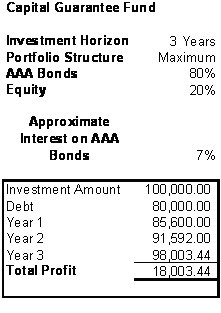
Capital 'Safety' looks to be the new buzzword in Mutual Funds. Interestingly I looked at the offers coming from one of the Mutual Funds. Below is one of the schemes that is currently in offer. The scheme allows investor an option to invest in a 3 year or a 5 year scheme. I have just taken the 3 year for discussion. The investment in equity is a maximum of 20%. I have taken a conservative estimate on the debt side at 7%. At a minimum exposure in the debt side at 80%, the profit earned in the form of interest for the investor is Rs. 18000 or it covers most of the equity exposure that the investor is taking on the equity side of a maximum of Rs. 20,000. If the investor has to lose money on the scheme, then the equity market has to lose 90% of its value or the sensex value. Whoa! that is one pessimistic view of the markets.

I do not understand having such a scheme in the first place. Even if debt funds give 12% in the three years of investment, that gives about Rs. 9600 in profits. Unless the equity markets fall about 50%, this fund will not lose money.

Even in 2001 crash of equity markets, it took 3 years for the equity markets to fall. No fund manager would be that foolish to keep his money in the equity markets. If a change happens from equity markets to debt markets, he is bound to earn more, with fall in interest rates, giving capital appreciation on his debt portfolio, and reducing his chances of losing money.

I would have liked funds that sticks its neck out and is willing to take the risk on behalf of the investor. These funds will not lose money unless he makes something drastic on both the markets that he has to lose money to his unit-holders. A serious let-down to me! I guess SEBI is not willing to experiment as these are fund houses with awesome track records.

October 21, 2006

Under Pressure - Movie Theatres

Last time I was in a theatre, I was impressed by the infrastructure or rather the movie experience trying to be offered by FAME Adlabs. While there is much to be desired in-terms of service levels as I found it difficult to get my choice of food to take it inside the show yet I was happy considering that it was close to a private show with no one in the theatre except my gang of friends!

I am currently in Indore and it was really difficult to watch a movie as they were hardly any good theatres to talk of. Well enter the consumer age and things have rapidly changed over the past year. Three big multiplexes has reached this place. FAME Adlabs, PVR Cinemas and Inox. With an average of 4-6 screens, these corporate theater companies can house close to 1200 people at any given point in time.

Given the nature of this business, where people do not want to watch movies in theatres twice or thrice as it was earlier, most of these theatres need to reach to the audience really fast. Enter the idea of more than the standard number of shows per day with odd hour shows. Even if this were not enough, multiple screens are being used to show the same movie. Something that was close to a taboo in earlier days.

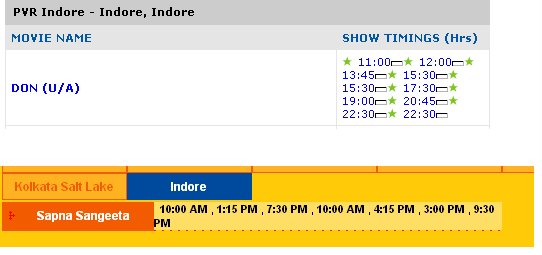
A good friend of mine was looking at the availability of tickets for DON, a new movie of Shah Rukh Khan in Indore. The results that came out was astonishing. I have attached two clippets on the same below from two of the four important theaters in Indore that follow a similar business model. The number of shows/day that was shown by these theatres in the next few days exceed 30! At an average 250 seats/screen, this translates to 7500 a day and for a week this will be 90000. At a 85% utilization rate and a cost of Rs. 125/ ticket, Indore citizens are going to spend a crore on movie watching this week for DON ! Phew that is a lot for a movie. What are the plans for the second and third week or the next month? Who is there to watch this movie in such a big theater? If I were to add the cost of the eatables, parking for this movie, another Rs. 100-125 is going to go off most of them. Movies are getting expensive!


Movies has taken a new turn today. It is no more the number of days that makes a difference to the director. No more do you see movies harping on running for 100 days, 200 days etc. It is how much money do you make during the first week, how much did you lose over the previous week, marginal loss in ticket sales!

It is important that we look at new-age theatres in a new light because the business model for most of these companies has changed.
  • Most of them are looking at first week sales quite closely. Quite evident from the number of shows shown.
  • Movies are getting extremely short-lived. The theater companies can be blamed for this. In their primary interest of capturing most of the movie-goers to their screens, they are showing more shows leading to lesser number of days for a movie. For people like me who like watching after the initial euphoria dies down, I end up missing most of them as they are never there on screens at a later date.
  • New initiatives like SMS Booking and Internet booking makes sense to most of us. While I do not know the risks faced by these companies, I see this model making some change as there is no need to stand in a line, the ticket is confirmed and no anxiety is associated with getting tickets.
  • Companies are also looking at the food counter closely. I know Satyam in Chennai did outsource this section thus making it profitable for them. Today, we tend to take something during the first section of the movie too rather than having something during and after intermission.
  • Pricing has changed for the tickets. They are getting extremely expensive. The reason primarily arises from the huge infrastructure and maintenance costs for these theatres.
  • With most of them running empty during the week and the non-availability of good movies at all times, good movies is getting expensive and so does huge variation in movies during the weekends and weekdays.
Understanding the Industry for any valuation

  • It is nice to see the business model changing, it is even better to see an active corporatisation in theater distribution. Corporatisation is making distribution system. Earlier we had theater owners with less than 3-4 screens. Now companies like Inox, PVR Cinemas and Adlabs are consolidating the screens around the country. Directors can start actively looking at negotiating with the screen owners rather than the old model of having the middlemen. The old system can't die this early with the penetration still low in the Tier 2-Tier 3 cities but there is a step towards this direction. Also, this increases the bargaining power for these companies for better revenue sharing.
  • Business revenues has changed drastically. What was earlier a function of days with a standard set of shows for a movie has now changed to more than 5 shows a day/screen to multiple screens for the same movie. This makes modelling more difficult as a bad movie can just see audience vanish creating huge unutilized seat for a screen and this will lead to huge unrecoverable variable costs.
  • Also, weekdays and weekend pricing will start seeing some changes. With unutilizated capacity, price cutting will get into the place between theatres making it even more difficult. As most of these companies are still expanding, revenues from existing theaters has still not stabilized.
  • This business is getting a bit murkier for an investor because there is hardly much to distinguish between the theatres. I am yet to see loyalty to any of these theaters by the audience.
  • Business revenues are coming not only from ticket sales but also from the food counter. On a average every customer spends on a coke and a popcorn for two people. This is a revenue of close to Rs. 50 and a margin of around 60%. This is a strong stream and one that should not be overlooked.
Valuation of such business is extremely difficult and unless we see some clarity, of which 'time' is the best master, any approach would lead to extremely diverse pricing models for these companies. Once we see most of these companies stop expanding, one can start valuing these companies with better clarity!

October 06, 2006

Glenmark - PR activities

Hi,
This is something interesting that I am seeing as a good PR initiative for a company that is looking to come out of the woods when in trouble. There was a recent news on the company being alleged with anti-asthmatic drug that is choking people. The clarification of the drug effects is available at the company website or you can click on the link below


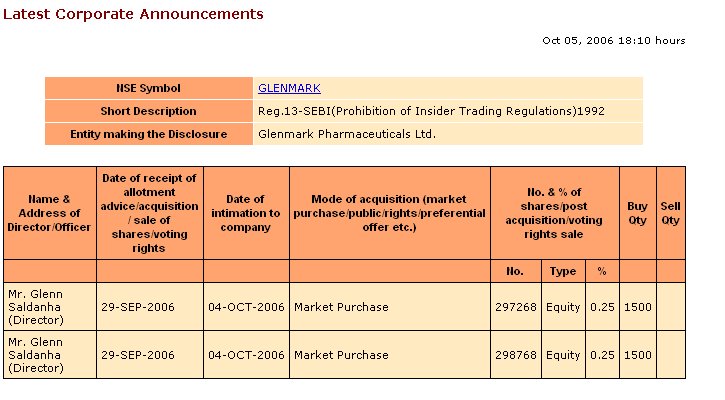
This was in the NSE website yesterday in corporate communication:

The shares of this company has fallen by more than 15% with this news. The stock movement is available at knowcharts.blogspot.com

The director has now come now to buy the shares of his company to possibly indicate that he is happy with the performance of the drug and is willing to increase stake in his own stock. While this idea is sincerely appreciable I would have preferred if they increased their purchases some more. This purchase by both the directors is less than 0.05% of their existing portfolio, Rs. 4.5 lakhs each. The directors have also taken sometime to respond with this initiative. But yet, I like this initiative better than investing heavily in an advertising campaign which is expensive and may result in similar results on a cost-effectiveness basis.

His indian market would not affected much as the patients hardly ever look at the manufacturer of a drug and his extensive sales network will ensure that the news of their version of the 'correct information' reaches all doctors instantly, thus reducing his downside.

Overall, good idea!!

September 28, 2006

DCB - Aggressively Priced

Well, an issue that throws more surprises than ever!

A company that has
  • a criminal case pending on fraudulent deposits
  • an increasing losses in its income statement and negative cash flows for the past three years
  • huge write offs because of its poor portfolio
  • to now give existing shareholders fresh equity at a lower cost, a discount of 63% over its previous issue which happened in February this year
  • been bordering on Capital Adequacy Ratio (CAR) at 9% and is compulsory lending lower amounts to maintain this margin
  • currently wants to create a niche in banking by being in selected cities only!! What is the use of it is beyond comprehension!


Issue Details

No of share : 7.15 crore shares
Issue Size : 157.3 crores on the lower side and 185.9 crores on the higher side.
Date of the IPO : September 29, 2006 - October 6, 2006
Price : Rs. 22- 26
Post Equity Issue Dilution : 48.43% will be the free float for this bank
Lead Runners : JM Morgan Stanley and ENAM Financial
Net NPA Details : Currently down from 4.5% to 4.05% in three months
Gross NPA : around 14% of advances


Objectives of the Issue and the mission of the bank
  • To raise capital for funding and meeting their Capital Adequacy Ratio
  • To focus on improving low cost funds through acquisition of CASA accounts
  • To grow fee based income
  • Build a based call center and enhance retail presence
  • Focus on a few states and build a strong sales team


Company Overview

It was setup as a new private sector bank. The company has 72 branches. Of which 26 are located in Mumbai. It has presence in Maharashtra, Gujarat and Andhra Pradesh. AKFED are its in-principal promoters and not from India. They established this bank after two consolidation in the banking history of theirs. They have a significant stake of approximately 60% which they intend to reduce it to 30% by the end of this issue. The bank is predominantly an SME bank. They focus on customers with less than 10 crores of business. They have a fairly large aggressive retail division that is contributing to their bottomline.The management is something to cheer about. It is headed by some strong people today. Mr Vijay Kelkar is in their board too. Most of them are non-executive directors.


Positives

  • While the company is saddled with NPA's, since 2003 the company has done well wrt to NPA's as it has reduced to .75% net. It has burdened itself with current net NPA's at 4.05% or 78 crores.
  • A professional board with immense experience of Dr. Vijay Kelkar, Anuroop Singh from ANZ etc which will help the bank in strong regulatory mechanisms.
  • Setting up a call center will enhance the delivery model for the bank as it will be cheaper to solve a customers problem and creates an alternate sales channel.
  • Customers are in the mid segment and the possibility of charging higher prices is probable. Hence, given the focus on low cost deposits, this can translate to higher net spreads from the current 3%.
  • The bank in view of poor performance has taken amends to reduce its losses. It has reduced salary, stationary, postage charges, directors and auditors fees.
  • The bank has a strong tax-shield with its accumulated losses. It has around Rs.50 of losses currently. Profits on this can be adjusted for the same. At 30% tax rate, this will give the shareholder of Rs.16 as a tax protection. Assuming this comes in the next ten years in an incremental basis there is still about Rs.6 on NPV basis.

Negatives
  • The branch network of the bank is extremely weak. Of the 72 branches that the bank has 26 are located in Mumbai. 51 branches are located in three states constituting risk in raising money. Also, these three states, Maharashtra, Andhra Pradesh and Gujarat has strong network of banks.
  • The banks internal controls on group exposure is at risk. One group has an exposure to 38% of its total capital!
  • The gross NPA that the bank has shown does not give much information. 3 of the five sectors are growing well. I do not have much information on the chemicals, dyes and for the engineering segment. While there is much potential in this segment, however, considering the fact that one does not know the financial of these companies, it would be unfair to comment on the same.
  • Foreign Investors in this bank have an exposure upto 68% before this issue.
  • Cost of funds is 5.73%. SBI is currently at 4.73%. Most of the banks are at these levels.
  • The focus is only building branches, focusing on key areas for business banking.
  • The SME segment has a lot of focus with ICICI, HDFC and all MNCs giving a lot of importance. Nationalised banks and others were always there in this segment.
Financials of the company
The banks networth is near collapsing with around 170-200 crores erosion year after year.
The bank has really a very poor performance and unless they have their plans in place, this bank is headed for disaster. Their P/L shows increasing losses from 2003. Before this, they had an average profits mainly because of their revaluation of their assets. Their core income has been constantly reducing (30% in 6 years) and income from investments has reduced by 50% in the same time. Most of the other income barring lease rentals has remained or marginally increased in the past 6 years. Its interest outgo has also seen a corresponding decrease. But the employee cost and lease rentals has shot up the roof by more than 50%-60% in the same time.
There is an increase in the other expenses to the tune of 200 crores on a year to year basis with little explanation.


Capital Structure
This is probably the first time that I am seeing that the cost of the promoters capital is more than the issue price. The promoters are locking their shares for a period of one year. Also, AKFED, which has a share of 58% will have to dilute to less than 10%. There was a RBI circulation on foreign holding on a bank in India till 2009. The promoteres holding after this IPO will fall to 30%.ESOPs have been provided but its largely ineffective till the price reaches Rs. 40 and not in the next two years.


Interesting Facts
  • The bank has strong exposure with some select few companies. 5 industries, according to their classification has exposure of more than 30% of their funded exposure. Its top borrower has control of more than 19% of the capital. If I am to understand the banking laws, unless this is in infrastructure this just cant happen.
  • The bank has a customer base of only 6 Lakhs of which 5.95 Lakhs are in the retail segment.
  • There has been a sticker sent to all existing shareholders stating that the promoters will have their shares locked-in for a period of one year!
  • The bank has gross NPA at 14%, no wonder it is loss making.
  • The promoters company are not profit making and though it should not impact the bank, but such request for dividend declaration would be hard to resist.
  • Changing auditors rarely happen in a company, but this bank has changed its auditors thrice in five years. How come?
  • One can read the litigation section to have some pass-time in the entire section of the prospectus.

The pricing of this issue:

Comparing it on earnings would be unfair as the bank is loss making and only one quarter of profits is available. So I have taken the book value for comparison and have assumed the following. I have used a two stage relative valuation based on the book value for the company. The following are the key assumptions made

ROE: 14% for the future considering that it is a bank and the leverage is high

Cost of Equity at 12% (CAPM method : Risk Free at 7%, Beta: 1.1 Risk Premium : 5% will give 12.5% as cost of Equity)
Growth during the first 5 years will be 20% and the rest will be at 4%
Payout Ratio : 10% for the first five years and 40% from then onwards.
Based on the above assumptions the price to book value can be 1.02 times.

At the current bookprice of Rs.18, this will work out to Rs. 18.36, making it expensive by about 25%. However, if one adds the loss in the books and the benefits that it would derive out of it, this will translate to another Rs.6. giving a total of Rs.24 to the shareholder.


Summary:

I like the management as it is impressive. The bank may be a loss making company but they seem to be committed in improving it. The portfolio is straddled with poor assets which they seem to be determined to improve. The incremental NPA this year has been only 0.5% which is heartening to hear. I would be suspect of the profit that they are making today as they were clear on the coming IPO. The bank has a strong focus on a segment where the revenue generation is higher. Though the competition is heating up in this segment, I am still happy with the margins that can be charged. Given that the cost of borrowing is on the higher side, this is offset with a higher cost of lending. The bank has not lost on non-fee based income and has done well on that front. Given that these are non-funded incomes, the capital requirements would be lesser.

The issue has been fairly priced and if it does get subscribed to less than Rs. 22-23 it would be a good one. It is a good IPO and can be applied for the banks possible future performance.

September 24, 2006

Gayatri Projects Limited - Hands Down

IPO is back and it is a nice sight to see the number of companies rushing in to cash this opportunity before the stock market crashes. FIEM is currently running and Minar, GPL (this one), JHS and Hanung on the pipeline. So what is nice of this IPO. I saw the others and thought something on projects to be an interesting one as there could be something on infrastructure.

There are times when you wonder how some companies, that have done all the negative things can still raise money. This is one company that falls in that category.


Issue Details

No of Equity Shares : 29 Lakhs
Objective of the Issue : Videocon Aplliances and Videocon Industries are diluting their stake and there is a fresh issue of 10 Lakh shares
Employee Quota : Just 1 Lakh compared to the others that I have seen in percentage terms
Post Issue Dilution : 29% will be for public
Price : Rs. 275 -Rs. 295
Issue Size : Rs 79.75 crores to Rs. 85 crores
Dates : September 26-29, 2006
P/E : As of last years earnings it stands at 13-15 times


Overview of the Company

The company has been around for 16 years and has an experience in constucting over 600 kms of highways and 1113 kms of irrigation canals. It has a minor interest in building ports, airports, industrial works etc. It has experience in building dams (7 in total). It has a current book order of more than 1000 crores of which 40% constitute building of roads and irrigation completes the rest. Its joint ventures have a book size of Rs. 1350 crores with approximately 50% in road segment.


Objectives of the offer

The first objective of the company is to get a listing in BSE and it wants to giva an exit-option to its existing shareholders. The first part of the objective is something that is unique. This company is not in IT sector where the requirement for publicity is high. It is into key infrastructure projects and the financials, experience plays a higher degree of role than a brand name.The company is borrowing in excess of 28 crores of which 20 crores would go to fund an SPV and the rest is to retire its debt. It currently has debt in excess of 250 crores and I do not know how this small change of 8 crores will make any impact.


Understanding the Financials

  • The company has close to 60% of its balance sheet in working capital. Of its current assets, 85% is locked in inventories, loans and advances and sundry debtors.
  • The current D/E is close to 2.75
  • Work Expenditure which contributes close to 80% of the cost has been reducing over the years, indicating some pricing power
  • The company has had a strong cash flow from its operations last year. This is highly fluctuating for the company with negative CFO in 2003-04. The company has too much debt in its portfolio that is carrying with a higher cost.

Positives

  • The company has recently got a working capital loan from a bank for Rs. 165 crores. As a bank has allowed this, the company's financial might be getting better with good projects on hand.
  • Work Expenditure which contributes close to 80% of the cost has been reducing over the years, indicating some pricing power

Capital Structure

  • Well, this issue will make the promoter richer by 62 times on the lower side. Apart from it, the company has been issuing shares to its promoters at face value. There has been no infusion of capital since 1994. However, the company has capitalized its reserves by giving bonuses to its existing shareholders. The plan for the IPO has been in place for the past year as the company gave a bonus last year.
  • With this issue, Videocon will completely come out of the venture. 16% of the equity capital is held by IL&FS and 2i. This part of the equity capital is not sticky and they can sell their issue at any time of their choice.
  • D/E is close to 2.75, an average running with its peers

Negatives
  • Management is extremely poor and the details have been given on the risk section.
  • Dividend policy of the company for one of its group companies is at a big doubt. The company was incurring losses from the start but the company declared dividend. I do not know from where did the money came from to declare the dividend.
  • The company's debt book is simply stunning with average age of 10 years. The company does not look to be in a position to recover this money and it exceeds 100 crores.
  • The company does not believe in maintaining its assets. No AMC has been taken on its assets and it has written that its assets in construction equipment etc as one of its key strengths!
  • The company has given guarantees amounting to Rs.233 crores to its group companies.
  • Interest Coverage Ratio is only 1.75 times, this is extremely low for a company that is heavily leveraged. Small changes in revenue can wipe out its profits.
  • As its loans are secured, this can create a bottleneck in its operations. This ratio has been improving over the years, but still in a dangerous territory.
  • The company is using the exit as a route to raise money too. The SPV has a cost of Rs. 20 crores and this issue is expected to give Rs. 27.5 crores for the company and the remaining money is used to retire its debt.

Risks

Management

  • One of its groups companies has a criminal complaint for non-payment of a lease rental. Though it is for a small sum, it still raises some concern on the quality of management.
  • Two of its companies have been suspended from trading for non-payment. The company paid the fees for re-listing last year. It looks like the company wanted to have a clean sheet before this IPO. Unfortunately, BSE is yet to give a clearance as these companies is yet to start commercial production.
  • The litigation against the company is quite high at 80. Civil, Debt recovery tribunal and sales tax being the key ones. The total exposure in these cases is close to 90 crores. Group companies and the promoters have not been spared either.
  • 11 of the 17 companies have negative networth.
  • The company has been doing a lot of inter-firm transfers. A total of 250 crores have been reported in this section but then most of them are acceptable transactions

Interesting Facts

I do not know if this true. This security is for listing only in BSE and not in NSE. However, I got the prospectus from NSE. Videocon must not have been too happy with this venture. The investment has generated close to 16% p.a. since its investment in 1994 excluding dividends. With 16% of the capital held by FIs with no lock-in, this stock can open with some profit booking. However, the management has been so poor that I would not regret having missed this issue.The company has priced on relative earnings and the company has priced it on the lower side. However, consider the D/E of the company with its peers, it is still on the higher side and its RoNW is at best - average.


This stock is a pure exit strategy for Videocon and borrowing for the SPV. The company's financials are by no means strong. There are too many litigations indicating poor management. FIs can pull the price down at the open of this issue and as investor apart from the sector it is playing in, nothing else is close to being attractive.


Gayatri Projects - Hands down for this IPO

September 23, 2006

Research Reports - The Fun of reading it

I enjoy reading research reports. There have been instances in the past when research analysts post reviews that are opposite in nature for the same event. An example of this was with SBI when the results were posted for the third quarter. Two research agencies, extremely reputed gave exactly the same reasons, but had a final outcome that was diametrically opposite.

Here is another instance of another research company. As an amateur analyst myself, I know how difficult it is to estimate the cash flows for a company. The company in this case is OMAX Auto. There was a recent 'buy' order from this reputed research agency. I went on reading it and I found the section of financials interesting. The company had given an expectation of the following in the previous year.


Consider the same the next year in the following. The research predicted that the company would have a sales figure of Rs 662 crores while the actual sales for the company was only Rs 578 crores. This increase is only 9% when the projected rate was approximately 25%.
The reasons that were cited were as follows.
  • Employee cost : This amounts to close to 5 crores
  • Power cost : This contributes to 5% of the cost. It was about 17 crores last year and this year it is at 24 crores. Of this 10% was the natural growth of sales. Hence it was already incorporated in the financials. The increase was only 5 crores.
  • Interest cost : This is a reason that is unacceptable as the capex plans was already given in the previous year and their model should have incorporated this high cost.
  • The company has saved 2% of sales which amounts to 11.76 crores
If one adds all these that the company has mentioned, they should have still got the profit that they had predicted as the cost of savings from raw materials has been offset with the increased cost in salary and power. Yet, they missed the mark by a big margin. Why cheat the investor for something that the company is not able to deliver? The research report completely ignored the poor sales forecast that it did and blamed the entire game onto the management for ineffective performance. Now, this is unfair. How is the company at fault when your forecast was way off-mark.

The answer lies somewhere in an article that I read recently by Paragh Parekh. He was in our institute to give a guest lecture and I truly enjoyed the subject on "behavioral Finance" that he taught that day. However, coming to this issue, he mentioned that the research agencies have targets on the number of reports that they need to generate in a year! I was stumped to see it and now after reading this, I find it believable. I have no solutions to this issue. But then, I think the research house should
  • show the research agency's previous call on this company
  • give reasons for a downgrade for this company
  • the number of times it has downgraded on the whole for all companies that it normally researches
  • the frequency of such changes and the timing of such changes
Now, as a research agency, I can still escape by giving a reason of higher interest rates or higher risks or high beta that will be built in the CAPM to confuse the common reader. True, it can happen but atleast I do know that the company has some reasons for the change in such forecasts.

September 22, 2006

Speculation Rocks


I was surprised when I was reading this document from NSE on a derivative update. Read the section on stock futures. We simply beat the nearest exchange 'hands down'. We enjoy taking risks and especially in the futures segment and not in the options segment. 15th in stock options and 9th in index options. We rank 1st in stock futures and 3rd in index futures.

Index options where it is probably easier to speculate as the only risk that one takes is a systemic risk. NSE stands 9th in this section. We are probably more risk takers than the rest of the world or probably too much 'inside information' at play. If one reads the entire document, one sees that the retail participation is extremely high (more than 50%).

God! This is scary

September 19, 2006

DFIs Shrinking Spreads or Rising NPAs

Typewriters saw its end with the introduction of computers and so did the bicycles after motor vehicles. Is it time to see the slow death of financial mammoths called Development Financial Institutions (DFIs) and the rise of capital market and banks to replace them?

Post World War II, several countries nearly depleted with capital resources, struggling to develop their financial and labour capital, infrastructure. Banks with its limited expertise charged high premium for projects with large gestation periods could never meet the demands of these projects. This gave birth to special institutions called Development Financial Institutions (DFI) to act as a ‘gap-filler’ with the following mandate

  • Providing medium and long-term assistance to business undertakings in the form of loans, underwriting and investment and fill the gap created by banks who confined to short term financing and selective investing and a poorly developed financial market
  • Assisting new project ideas, undertaking feasibility studies, providing technical, financial and managerial assistance for the implementation of projects
Different countries have followed different objectives such as financing, promotion, building technical expertise for the functioning of DFI. Countries like Germany, Korea and Japan have transformed or devolved their DFIs after having attained the objective and with the better access to capital markets. India today is straddled with DFI under huge NPAs. This paper aims to establish that it is not only shrinking spreads and NPAs but more than that and the future of
DFI.

Looking back into its past

RBI was entrusted with the responsibility of building the success story of the DFI in our country. The Industrial Finance Corporation (IFCI) was the first special financial institution established in 1948 by an Act of the Parliament. This was followed with establishing State Financial Corporations (SFC) in 1951; currently there are 18 SFCs, ICICI in 1955, LIC in 1956, Agricultural Refinance Corporation (ARC), UTI and IDBI in 1964, RECL and HUDCO in 1969-70, 70, Industrial Reconstruction Corporation of India Ltd. (precursor of IIBI Ltd.) in 1971 and GIC in 1972. There are currently 52 institutions in this category.

Financial Health

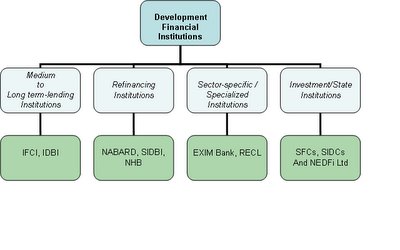
The classification to understand the financial health for the DFI has been done in two broad areas: FIs are regulated and supervised by RBI and FIs that are not under the direct purview of the RBI. IFCI and IIBI which have been operating as providers of direct assistance are all in poor financial health while refinancing institutions such as NABARD, SIDBI, NHB, EXIM Bank, IDFC have done really well in maintaining strong financials year on year.

The most inefficient among DFIs are State established SFCs. In states like Orissa, Bihar, TN, W Bengal, Maharashtra, Haryana and Gujarat, these institutions have eroded their entire networth and have neither been able to raise fresh funds nor service their debt requirements. The causes for the same have been explained in detail below.


The causes of decline in the 90s

IDBI, ICICI and IFCI formed the triumvirate on which the country's project finance edifice rested. Of these, ICICI rapidly changed to face the challenges of the new competition while IDBI was forced to change when faced with huge losses. However, IFCI’s future is still undecided. A look into what caused their decline in the 90s will show the following reasons

Evolution of the Indian Banking System
The Indian Banking system is today well diversified with public, private and foreign banks competing for similar businesses. The expertise they have acquired to manage risks in extending finance to long term projects has reduced the need of DFI. The credit given by banks and DFIs as a percentage of GDP has increased from 3.9% in 1971-1992 to 4.3% in 1992-2000 .

Competition – A driving force for effective performance
UTI mutual fund today faces competition from more than 30 other mutual fund companies. LIC competes with Prudential ICICI, Tata AIG, Bajaj Allianz etc. In the long term financing, there has hardly been competition. Being monoliths, IFCI, IIBI and erstwhile IDBI had poor loan appraisal mechanisms, ineffective regulation leading to mismanagement.

Riding the Low Cost Advantage of banks
Banks enjoy the natural advantage of having easy access to lost cost funds, a primary contention for DFIs. With RBI removing the LTO option for raising funds, DFIs were forced to raise funds from the market. DFIs are forced to lend to projects at rates that could make the loan unfeasible for them to service its cost of borrowing. The average cost of borrowing for SBI in 1997 was 6.3%, whereas the cost of borrowing for IFCI was above 10%. While the cost has reduced to 4.5% for the current year, it still remains the same for IFCI.

Poor asset distribution leading to NPA’s
DFI had the following issues: High sector exposure , cyclical nature of business, limited checks with group and company, long term loans led to disproportionate asset distribution. SFCs, on the other hand had been extending term-loans to SSIs. They were burdened with high operational cost, poor assessing skills, and were extremely bureaucratic. It is estimated that they would require around 3600 crores of capital infusion to clean their balance sheet.

Indiscriminate disbursement of loans
IDBI disbursement was growing at a rate of 14 per cent, ICICI at 27%, and IFCI at 20% since 1992-93 when the industrial growth in the country has stagnated around 3.5 per cent to 4 per cent indicating poor appraisal mechanisms.

Development of the Indian Capital market
One of the primary objectives of DFI was to act as a ‘gap-filler’ in the capital market and help lending medium to long term loans. The resource mobilized in the capital market in the form of debt and equity as a percentage of GDP has increased from 0.6% in 1971-1992 to 1.7% in 1992-2000 .

Others
The Public Undertakings Committee found SFCs
  • Not following stipulated guidelines while sanctioning loans
  • Lack of constant monitoring leading to misuse of funds
  • Poor collection mechanisms
  • Corruption and heavy sectoral exposure
  • Political Interference

International Outlook on DFI

Internationally, DFIs have had significant changes in their functioning over a period of time. There have been two distinct models followed:
  • Anglo American: Market based which competed for resources
  • Continental Europe and South East Asian Economies: Financial savings was diverted to these FIs for investment.
Of the four DFIs in Japan, one was restructured and the objectives realigned to meet social challenges and the rest went bankrupt and sold to private banks. Korea’s DFI has constant shifted to focus the requirements of its government. Singapore’s Development Bank of Singapore (DBS) now functions as a full fledged commercial bank.

Recommendations on the future of DFI

Given the importance of DFIs role in as a ‘gap-filler’, the following are the key recommendations and shall be discussed on the basis of classification

Refinancing Institutions
NHB, SIDBI and NABARD can continue their status as a DFI till the existence of DFIs. However, they need to act as regulators for the section they are re-financing.

Sector Specific/Specialized Institutions

No changes are required to specialized institutions such as LIC, UTI, and EXIM bank etc. as they are competitive players and strong regulators. TFCI, National Co-operative Development Corporation and National Dairy Development Board should be converted to a NBFC and will be easier as they are profitable too .

Medium to Long Term Lending Institutions

Barring IDFC, IFCI, IDFC have shown heavy losses. The following are the options that are available for a turn-around.

Create an SPV or transfer them to IFCIs ARC Having completed this, the DFIs can be converted to a bank or an NBFC for the following reasons
  • DFIs need to be given access to markets to raise low cost loans
  • DFIs can cause systemic failures by not servicing their debt to insurance companies, pension funds. Hence, active regulation and portfolio monitoring will be needed from RBI.
  • By deepening our debt market the dependency for DFIs will reduce

Devolving the system of DFI:

Converting them to banks or partnering with an existing bank

The success of ICICI’s conversion to bank and the recent make-over of IDBI to a bank but with a DFI status, gives a strong case for converting the existing DFIs to a bank. However, converting to a bank is not fraught without risks.
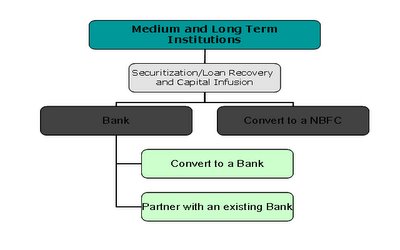
Partnering or Converting to a bank: A discussion
Establishing a bank will require
  • Replicating an existing bank with no assurance of access to low cost deposits
  • Longer Time requirement
  • Heavy investment in technology
  • Statutory requirements to be met with your current portfolio
Given these conditions, it is advisable for institutions such as IFCI or IIBI to merge itself to another bank than converting to a bank . RBI should allow these banks to raise long term loans through issue of ‘Development Bonds’ to fund the projects the DFIs have expertise in.

Converting into an NBFC
It would be ideal to see most of these institutions as NBFCs than DFIs as they can be regulated by RBI.
  • Regulations can be relaxed on CRAR for profit making NBFCs of DFI nature .
  • Active securitization of loans to help deepen the market.
  • Compulsory investment from pension funds, postal savings in the lines of Korea.
  • Diversification into wholesale banking including term finance, working capital finance, cash management services, equity to projects. Others include exposure to sector, group and individual companies.
State Financial Institutions - A stronger dose

In spite of commendable performance from Delhi SFC, APSFC (NPA’s currently at 16%) significant restructuring is imperative. The following are some of the key recommendations for SFCs.

Short Term Solution
Consolidate the bad portfolios of all SFCs and transfer to an SPV that works like in IFCI
  • IDBI and SIDBI can restructure their loan exposure or convert them to equity. There would be a requirement of infusing close to 3600 crores from most states.
  • An effective VRS , requiring close to 230 crores will be needed to reduce employee overheads that contribute 15-50% to less than 1-3% .
  • Appoint a professional non-executive chairman with banking and finance experience and boards with experienced professionals, implement managementinformation system, adopt standard accounting practices and the EDIFAR should be updated with the defaulters list.
  • Cross-sell other products and increase fee businesses.
  • Prudent norms on exposure limits, in lines of banks, to specific industries must be established. Diversification of portfolio will ensure reductionof risk during adverse times.

Long Term solution

Banks have gained expertise in analyzing risk and have slowly started to increase their presence with in all segments including micro-finance . Given this current scenario SFCs have outlived their utility and should be phased out within a definite time frame. However, changing to a bank in the long run would be difficult. The opportunity should be constantly monitored and converted to a bank or an NBFC that can absorb the SFCs without affecting its statutory requirements.

Conclusion

DFIs had been the cutting edge of the Indian financial system and enjoyed high credibility as a more than being a ‘gap-filler’ .Recent losses with IFCI, IIBI, SFCs has changed the scenario. However, barring these few DFIs, others such as NABARD, SIDBI, NHB, and IRFC have done exceedingly well. However, the need has come to address these losses and look at the future of these institutions.

The government of India cannot escape from its obligation to bail out the sick DFIs. As long as the present legal structure makes it difficult to force delinquent borrowers to pay up, DFIs may have no option but to look up to the government. It can be argued that the current problem of NPAs of DFIs is itself partly the result of the acts of omission and commission of the government. It goes without saying that the long term remedy to the DFIs’ problem lies in the
development of the debt market. Converting them to a bank, that have gained the expertise of strong loan appraisal mechanisms, cheaper source of credit, better collection systems and active monitoring of disbursals and regulatory check would be more appropriate for the future of DFIs. However, it should be at the discretion of the DFIs. Active securitization, allowing long term development bonds, diversification, sectoral caps will further benefit by removing systemic shocks. It is much more than a combination of shrinking spreads or rising NPA’s that gets addressed.

September 13, 2006

Fines and the sham of it

Here are some interesting articles and something that I always thought was unfair. Read them at your leisure time and it has very little relevance to what I am planning to discuss today-
For some of us, clicking and reading is even more difficult than reading it here. I just sent the link to show that they exist and it is no fabrication from my side. Hence, I shall give a brief on most of them. Merrill Lynch was asked to justify their trades that they advertise as there was a 'big' mismatch between them and NYSE. Canara Bank was imposed with a 5 lakh fine for not maintaining the statutory requirements and the IPO scam is well known to most of us.

I shall just take the case of Canara Bank as it is easy for me to put my point across. Its fine was not maintaining the fortnightly balances on its CRR and SLR requirements as 'somehow' some balances from its branches was unnoticed by the head office. Not that it is impossible considering the number of branches it has, but then I always amazed at the power of modern technology in tracking everything, including me. Yet, it happened. Was this intentional, don't know. There was no 'show-cause' notice given to the public. If I was to look at it differently, things show a really different picture.

What if I did it intentionally. Look at Canara Bank's balance sheet. This incident happened sometime this year. The closing balance sheet deposits was close to 116000 crores. The company has to maintain CRR and SLR requirements on this-5% and 25%. The bank was fined 5 Lakhs for this. A small math calculation reveals this - Assuming that the company had invested the money in AAA rated 10 year paper instead of holding it in cash and G-Secs. So the bank should have maintained 34800 in CRR and SLR. Had the bank invested in AAA rated paper and the differential was 3%, this will boil to 2.86 crores for a day. Assuming it takes 2 months for the decision to take place and the fine to be given to RBI and as a good company invest the same in call market that is earning 5% returns. The bank shall now get approximately 7 lakhs as further interest. Have not gone scot free in this transaction. What has the company lost in this? A little bit on the brand value. Well, this is a financial transaction and will get reported mostly in business papers in a small section of a relatively irrelevant side or page where there is nothing else to fill. The bank can explain different reasons and accept that it was a mistake beyond its control. But was it?

The point was never to give a bad picture. I have been with Canara Bank and in all probability this could have just been an accidental error from their side and never intentional. However, if I were to create such a scenario in front of you, is it right? RBI should have actually estimated the profit on this transaction and levied charges proportionate to it. Yet it levied a standard fine. Is the regulator right in his decision or just plain lazy to take note of it? Look at the Merrill Lynch and the IPO scam. The profit has already been taken and the goodwill for Merrill Lynch in terms of being the best broker has already been decided. The incremental business has been created. Will the fine that the regulator imposes reverse these transactions? I do not know. If I were to be unethical, I would happily do so albeit not regularly that I kill this cash cow opportunity.

But then, I can do it, can't I.


The point to be noted is that I am using these companies as an example to explain my thoughts. This is purely a thought process.